

CiteScore
0.7
Scopus
Aim. To analyze the structure of pathogens responsible for community-acquired urinary tract infections (UTIs) in the Russian Federation during 2022–2024.Andreeva E.M., Zakharova A.V., Izotova A.A., Kryukova N.O., Mikhailova L.V., Priputnevich T.V., Rafalskiy V.V., Roitman A.P., Shabanova N.E., Yakovlev S.V.
Introduction. Urinary tract infections (UTIs) are among the most common bacterial infections. Timely diagnosis and rational antimicrobial therapy of UTIs are highly relevant for a wide range of clinicians [1, 2]. In outpatient settings, acute uncomplicated cystitis is considered the most frequently encountered clinical form of UTI, occurring predominantly in women of reproductive age. For example, in the United States alone, the annual number of acute uncomplicated cystitis-related medical visits reaches approximately 7 million women [3].
According to official Russian epidemiological statistics, 4.1 million medical consultations for UTIs (ICD-10 N30.0–N30.9) were registered in 2022, of which about 60% were attributed to acute uncomplicated cystitis [4–6]. A survey conducted among young women demonstrated that at least one episode of dysuria associated with UTI had occurred in 20% of respondents, whereas 30% reported three or more dysuria recurrences within one year. It was found that symptoms of acute uncomplicated cystitis persisted for two to three days, during which respondents missed one to two days of work or study [6].
Antimicrobial agents remain the cornerstone of outpatient UTI management, and their use continues to grow annually. A U.S. study reported that nearly 15% of all outpatient antibiotics prescriptions were issued for UTI treatment [7]. In most cases, antibiotic selection is empirical and based on existing knowledge about the etiological spectrum and local susceptibility patterns of the most common uropathogens. Therefore, obtaining and regularly updating data on pathogen composition and antimicrobial susceptibility is an essential prerequisite for successful empirical UTI therapy [8–10].
Aim. To analyze the etiological structure of community-acquired UTIs in the Russian Federation during 2022–2024. Subsequent publications will present antimicrobial resistance data for the most commonly isolated UTI pathogens.
Materials and methods. We analyzed the results of 566,122 microbiological (culture-based) urine examinations performed in residents of 834 cities across 83 regions of the Russian Federation between 2022 and 2024. The study was carried out using real-world data (RWD) analytics technology. Laboratory RWD fragments were extracted from the databases of the InVitro laboratory network (https://www.invitro.ru/). Raw laboratory data were exported in a de-identified format from the laboratory information system as CSV files and processed using proprietary software for subsequent analysis.
The transformed datasets were stored as two-dimensional tables and analyzed through structured queries written in the Python programming language. The original algorithm for data transformation and analysis, the software, and the databases containing the processed information are protected by corresponding Russian Federation patents [11]. The study was approved by the Independent Ethics Committee of the Clinical Research Center of Immanuel Kant Baltic Federal University, protocol No. 49 dated 03.12.2024.
All urine samples were collected in outpatient healthcare settings according to a unified pre-analytical protocol. To minimize the risk of contamination, a standardized genital hygiene procedure was applied. Samples were delivered to local offices and laboratories of the InVitro network within 2 hours at ambient temperature or within 24 hours under refrigerated conditions. In 2022, urine samples were collected in sterile plastic transport containers Uri-swab (COPAN Diagnostics Inc., Italy). In 2023 and 2024, collection was performed using sterile plastic containers from various manufacturers; boric acid tubes were used for sample transfer and transportation. For transport within 24 hours of collection, vacuum tubes manufactured by LLC “MK RUSTEK” were used; for transport lasting 24 to 48 hours, Urine Monovette® tubes (SARSTEDT Group, Germany) or BD Vacutainer Plus Urine Tubes (Becton Dickinson and Company, USA) were used.
For microbial isolation, CLED agar (bioMérieux, France, or TsFGS, Russia) was used. In 2022, inoculation was performed automatically using the WASP system (Copan, Italy). In 2023–2024, inoculation was performed manually with a 10-µL calibrated microbiological loop in accordance with the clinical guidelines “Bacteriological Analysis of Urine,” 2014. Quantification of bacterial load (degree of bacteriuria) was performed by counting colony-forming units (CFU) obtained from 10 µL of urine and recalculating the result to 1 mL (CFU/ mL) [12]. The clinical significance of bacteriuria was determined according to the category of the isolated microorganism and the presence of UTI symptoms, assessed based on clinical information provided with the sample [12]. Samples with a bacterial load ≥104 CFU/ mL were subjected to identification and subsequent antimicrobial susceptibility testing. Samples containing more than two isolates were classified as contaminated and excluded from analysis. When two isolates were detected in a diagnostic concentration, the organism with the higher bacterial load was considered the primary pathogen.
Identification of pathogens was performed using the Biotyper Microflex MALDI-TOF mass spectrometer (Bruker Daltonics Inc.). Internal and external quality control procedures were conducted at least twice per year. External quality control was performed through the Federal System for External Quality Assessment of Clinical Laboratory Testing (FSVOK, Russia, www.fsvok. ru). For internal quality control, reference strains were used at least once per month for pathogen identification and antimicrobial susceptibility testing. During 2022–2024, the laboratory participated in the FSVOK program in the “clinical microbiology” category (two cycles per year), achieving satisfactory results in all assessments. The processed RWD contained sufficient clinical information to allow stratification of patients and analysis of specific UTI categories: UTIs in pregnant women, UTIs in children, UTIs in men, UTIs in women, as well as age-stratified subgroups.
The standard error (µ) of a sample proportion (ω) under repeated sampling was calculated using the formula: µ = √[ω (1 – ω) / n], where n is the sample size. The margin of error was calculated as: Δ = µ × t, where t is the confidence coefficient; for a confidence level of P = 0.954, the value t = 2 was used.
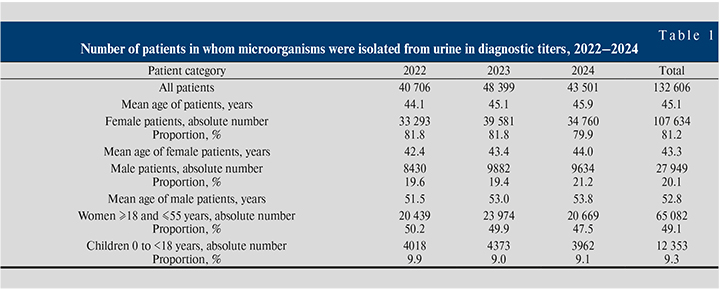
Results. The total number of microbiological (culture-based) urine tests performed was 177,959 in 2022, 202,683 in 2023, and 185,480 in 2024 (through August 1), amounting to 566,122 tests overall. Pathogens were isolated in 158,577 of 566,122 samples (2–8.01%), and a diagnostic bacterial load (≥104 CFU/mL) was detected in 132,606 patients (23.4%). Table 1 presents the distribution of urine samples overall and across clinically significant patient groups traditionally distinguished in UTI analyses. The mean age of patients was 45.1 years: 43.3 years among females and 52.8 years among males. Across all years, the distribution of patient subpopulations with community-acquired UTIs remained stable: females comprised 79.9-81.8%, males 19.4-21.2%, and children 9.0-9.3% of all included patients. The largest subgroup consisted of women aged 18-55 years (47.5-50.2%).
Analysis of the pathogen structure was performed in two steps. First, we examined samples in which only one isolate was detected (Table 2); such samples accounted for 132,606 cases (95.4%). In total, seven pathogens with a frequency >1% were identified: Escherichia coli (E. coli), Klebsiella pneumoniae, Enterococcus faecalis, Proteus mirabilis, Streptococcus agalactiae, Pseudomonas aeruginosa, and Staphylococcus saprophyticus.
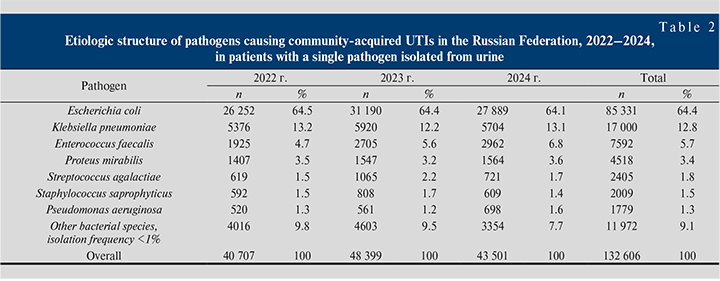
As expected, E. coli was the most prevalent pathogen throughout the study period (64.1–64.5%). Other Enterobacterales were isolated less frequently: K. pneumoniae (12.2-13.2%), P. mirabilis (3.2-3.6%). Among non-fermenting Gram-negative bacteria, the most frequent isolate was P. aeruginosa (1.2-1.6%). Among Gram-positive pathogens, the most common were E. faecalis (4.7-6.8%), S. agalactiae (1.5-2.2%), and S. saprophyticus (1.4-1.7%). Additionally, 45 minor pathogens were identified, each with a frequency below 1%. However, due to limited clinical metadata within the RWD dataset, their clinical significance cannot be reliably assessed, and they are not analyzed in the present article. These minor pathogens are unlikely to influence empiric therapy decisions.
Given the minimal year-to-year variability in pathogen frequencies, the present analysis combined data from 2022–2024. The pathogen structure of community-acquired UTIs may vary substantially depending on the characteristics of the patient subgroups in which these infections develop (Table 3). In particular, among men with UTIs, the proportion of E. coli decreases to 40.7%, and is even lower in the presence of benign prostatic hyperplasia (37.7%). Compared with the general population, the etiological role of K. pneumoniae and E. faecalis increases in men, reaching 21.4% and 11.7%, respectively. Men with UTIs are also characterized by a greater diversity of pathogens, especially in cases involving benign prostatic hyperplasia.
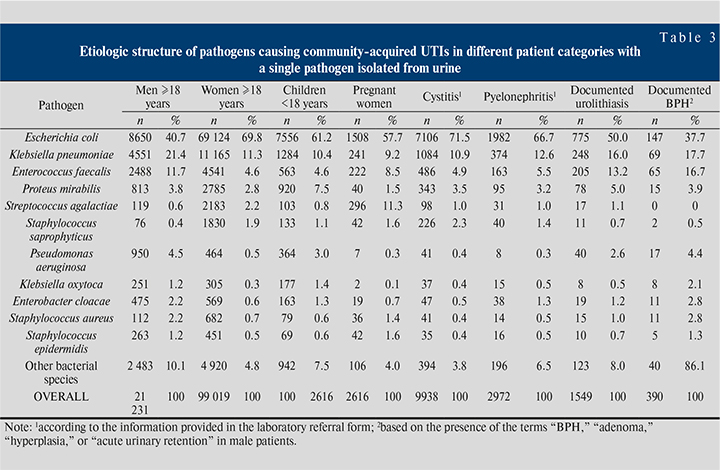
Patients with urolithiasis similarly demonstrate a reduced proportion of E. coli (50.0%), with increased frequencies of K. pneumoniae (16.0%) and E. faecalis (13.2%), and a more heterogeneous microbial composition. In pregnant women, a notable increase in the frequency of S. agalactiae isolation is observed, reaching 11.3%.
An analysis of the magnitude of bacterial load for different community-acquired UTI pathogens is shown in Fig. 1.
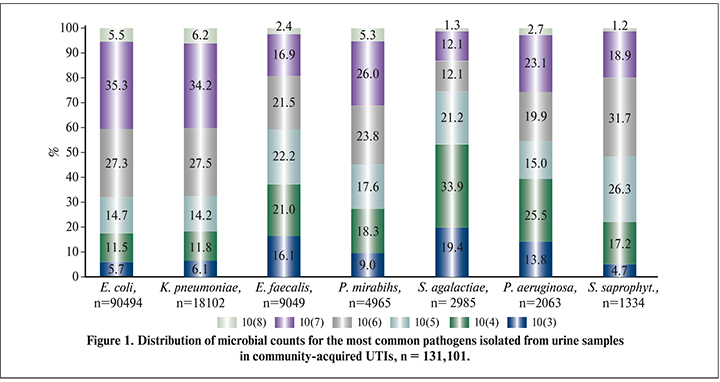
As illustrated, high bacterial counts (106-107 CFU/mL) are more characteristic of Gram-negative bacteria such as E. coli, K. pneumoniae, and P. mirabilis, accounting for 62.6%, 61.7%, and 49.8% of isolates, respectively. In contrast, the most common Gram-positive pathogens associated with community-acquired UTIs (E. faecalis and S. agalactiae) reached high titers (106–107 CFU/mL) less frequently, 38.4% and 24.2%, respectively.
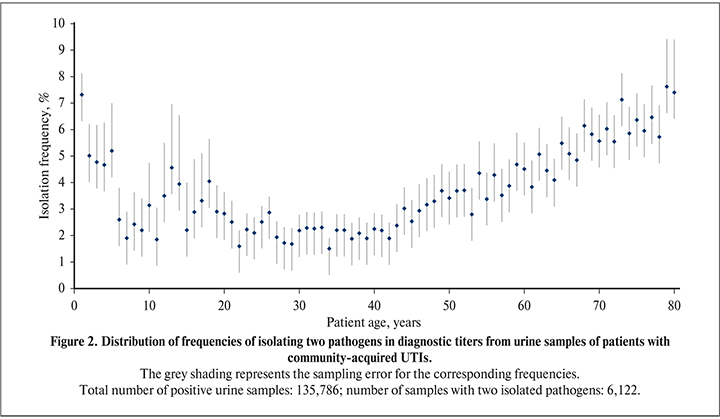
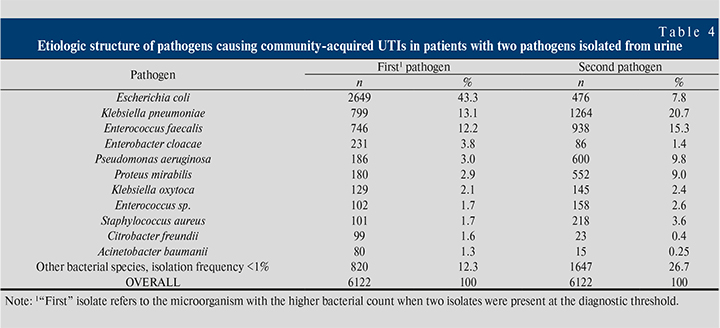
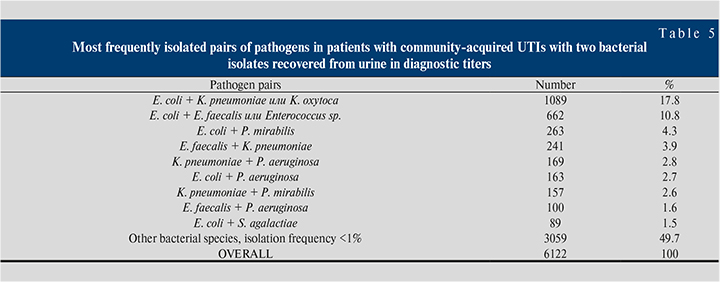
In the second stage of the analysis, we examined data from patients in whom two pathogens were simultaneously isolated at diagnostic titers during microbiological testing. A total of 6122 such cases were identified (4.5%). The frequency of isolating two pathogens varied substantially across age groups (Fig. 2): it remained consistently low (1–3%) in patients aged 18–45 years, increasing progressively from age 45–50 and reaching 7–8% by age 80. The pathogen structure in this category differed markedly, showing greater diversity and different prevalence of specific microorganisms as the “first” and “second” pathogen (Table 4). Although E. coli, K. pneumoniae, and E. faecalis remained the most common organisms, they occurred less frequently than in single-pathogen cases (43.3%, 13.1%, and 12.2%, respectively). Among “second” pathogens, the most frequent were K. pneumoniae (20.7%), E. faecalis (15.3%), P. aeruginosa (9.8%), P. mirabilis (9.0%), and S. aureus (3.6%). In total, 796 different combinations of microorganisms were identified among samples containing two pathogens at diagnostic levels. Nine combinations occurred with a frequency >1% (Table 5), the most common being E. coli + K. pneumoniae or K. oxytoca (17.8%) and E. coli + E. faecalis (10.8%).
The large sample size enabled extended data analysis, including the distribution of major community-acquired UTI pathogens across age groups with a one-year resolution. Figure 3 presents this distribution for E. coli among adult patients. E. coli remained the predominant pathogen across all age groups, with detection rates ranging from 59.0% to 73.8% in women and from 30.6% to 48.2% in men. The highest proportion of E. coli in women was observed between ages 38–55, with little year-to-year variability. In men, the prevalence of E. coli peaked at ages 20–50, followed by a marked decline.
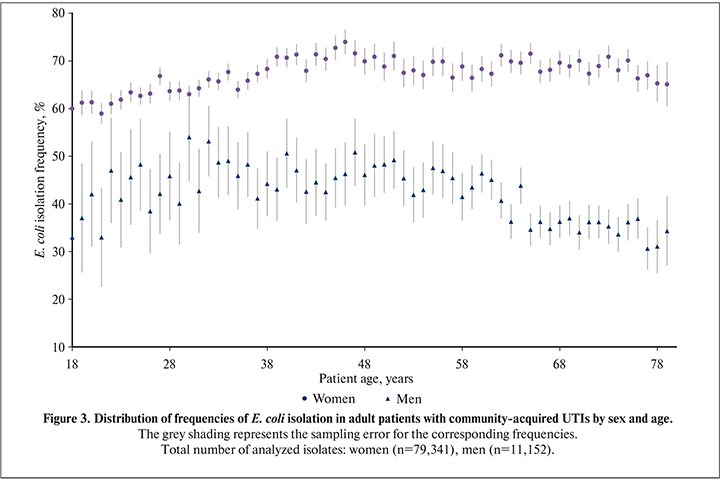
Figure 4 shows the distribution of E. coli isolates among children by age. E. coli remained the leading pathogen in all pediatric age groups, with detection rates ranging from 50.8% to 74.7% in girls and 27.7% to 47.9% in boys. A notable increase in E. coli frequency was observed among girls aged 6–8 years (reaching 73–74%), followed by a decrease to 50.8% at ages 13–15. Among boys, due to the smaller number of isolates and higher sampling error, similar trends could not be reliably identified.
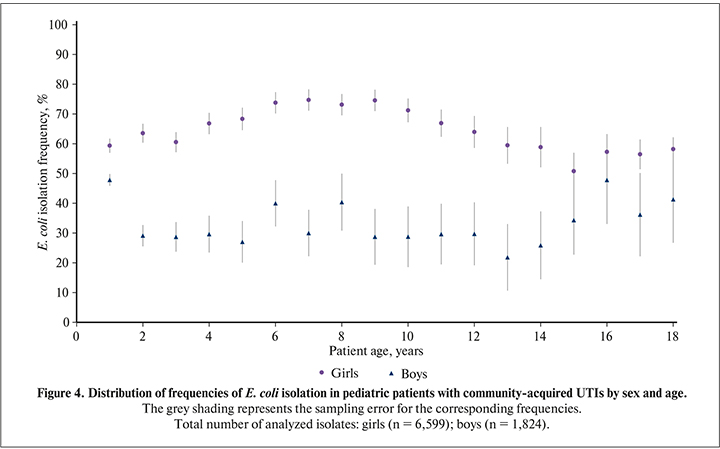
Figure 5 presents age-specific detection frequencies for the most common “non–E. coli” pathogens, namely K. pneumoniae and P. mirabilis, in both sexes with community-acquired UTIs. A significant increase in the detection of K. pneumoniae was observed beginning at ages 38–40 (regression coefficient R = 0.88, p < 0.05). In contrast, the detection frequency of P. mirabilis did not show statistically significant variation across age groups.
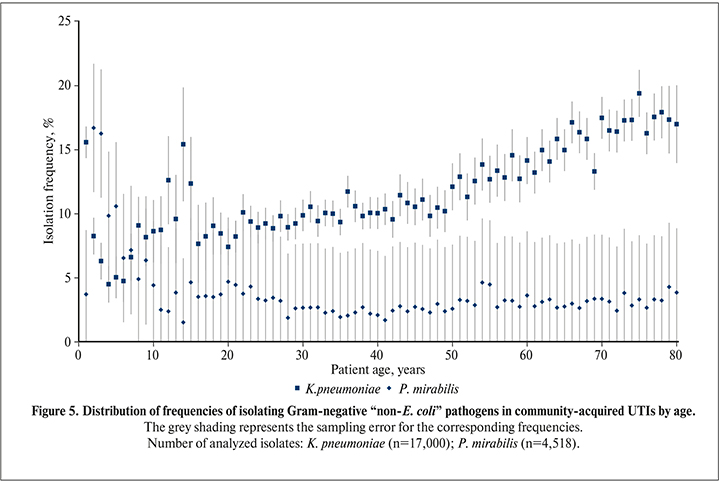
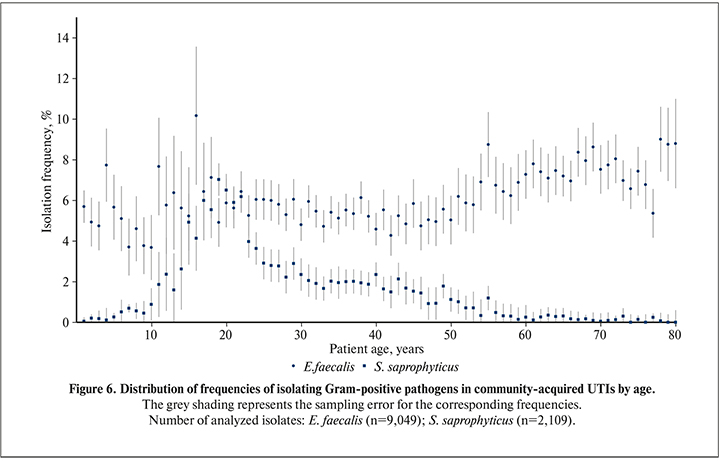
Figure 6 shows the age-specific detection frequencies for the most common Gram-positive pathogens (E. faecalis and S. saprophyticus) in male and female patients. An increase in E. faecalis detection was noted beginning at ages 40–50, although overall rates remained stable at 4–9%. The detection of S. saprophyticus was low (0–2%) in children aged 0–12 and in patients older than 45. An increase to 3–7% was observed in patients aged 15–30.
Given the clinical significance of S. agalactiae for obstetricians, gynecologists, and neonatologists, we analyzed its prevalence by sex, age, and pregnancy status (Fig. 7).
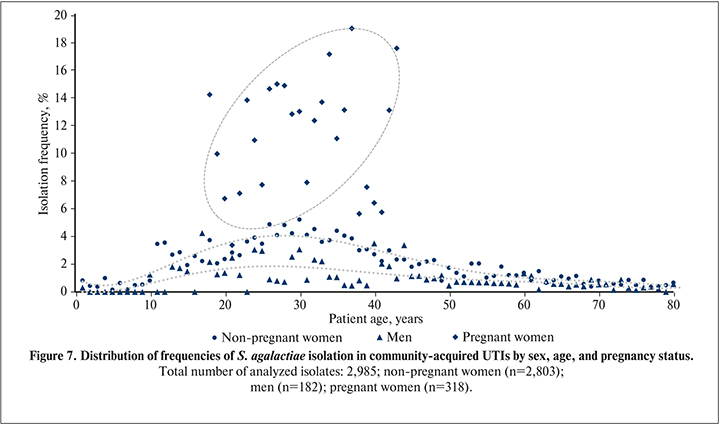
The study revealed a marked increase in the detection of this pathogen in pregnant women (6–19%), compared with non-pregnant women of the same age (2–5%) and men (0–2%).
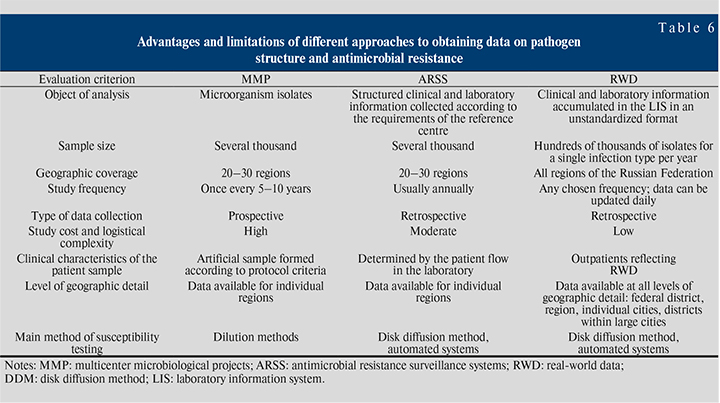
Discussion. The analysis of UTI pathogen distribution is critical for the rational selection of antimicrobial agents, as it enables correlation between the activity of antibiotics and the intrinsic susceptibility of typical UTI pathogens. Currently, several approaches are used to study pathogen structure and antimicrobial resistance, including multicenter microbiological projects (MMPs), antimicrobial resistance surveillance systems (ARSS), and the use of real-world clinical and laboratory data.
MMPs have been carried out regularly in Russia since 1998, including projects such as UTIAP 1–3, ARMID, ARIMB, DARMIS, DARMIS-2018, DARMIS-2023, and RESOURCE. Russian centers have also participated in analogous international studies, such as ARESC and NoDARS [13, 14].
Despite clear advantages, such as the use of reference susceptibility testing methods (broth microdilution), prospective data collection, and the availability of extensive clinical information, MMPs also have important limitations. The main limitation, in our view, is the restricted number of participating regions, the low frequency of data collection (once every 5 years), and the relatively small number of analyzed isolates (30–40 per region). In addition, sample collection in MMPs is typically performed in specialized medical institutions, including university hospitals, which may inadvertently introduce systematic bias by enrolling more complex patients, including those previously exposed to antimicrobial therapy. A further limiting factor is the high financial cost and significant organizational burden associated with carrying out MMPs.
ARSS involve systematic and continuous collection and analysis of microbiological data from regional laboratories without the transfer or storage of physical isolates. Examples include the National Antimicrobial Resistance Monitoring System (NARMS, USA), the Canadian Integrated Program for Antimicrobial Resistance Surveillance (CIPARS), and the Danish Integrated Antimicrobial Resistance Monitoring and Research Programme (DANMAP). Although ARSS avoid a number of shortcomings inherent to MMPs, these programs require participating laboratories to adhere to unified protocols and standards for data transfer and demand high levels of motivation and engagement.
The rapid digitalization of healthcare systems, the accumulation of large laboratory databases, and the development of data-mining tools have enabled effective use of RWD-based approaches for microbiological monitoring [15–17]. The use of RWD allows researchers to analyze large datasets and identify patterns that would be difficult to detect in relatively small samples. Such studies are increasingly in demand due to several advantages over MMPs and ARSS (Table 6).
A comparison of the findings from the present RESOURSE-2 study with analogous MMP-based projects is of particular interest. The DARMIS-2023 study was carried out during the same period as RESOURSE-2 and included 1098 isolates obtained in 29 centers across 21 Russian cities in 2023 [18]. In DARMIS-2023, as in RESOURSE-2, E. coli was the most frequently isolated pathogen from urine samples (64.5% and 71.7%; 69.8% and 75.5%; 40.7% and 43.9%; 61.2% and 68.9%; 71.5% and 77.6%; 66.7% and 65.6% in adults, women, men, children, cystitis, and pyelonephritis groups, respectively) (Table 7). Thus, there is a strong concordance in the frequency of E. coli isolation across different methodological approaches; mean differences did not exceed 5–6%.
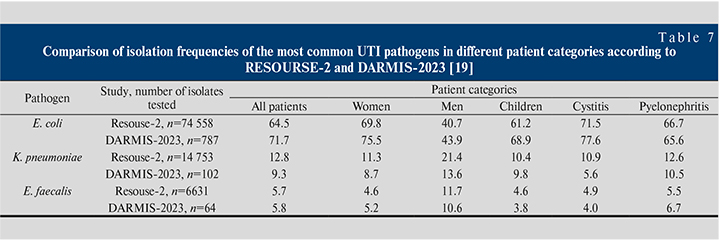
Isolation frequencies of K. pneumoniae and E. faecalis also showed good agreement between RESOURSE-2 and DARMIS-2023 across most patient categories. Minor discrepancies likely reflect differences in patient cohort composition rather than methodological variation in microbiological techniques. At the same time, our study demonstrated a notably higher frequency of K. pneumoniae among men compared with the corresponding male subgroup in DARMIS-2023 (21.4% vs. 13.6%). This may be attributable to the inclusion in RESOURSE-2 of men with concomitant prostate diseases. As shown earlier (Table 3), patients with benign prostatic hyperplasia exhibit an increased frequency of K. pneumoniae isolation.
An important feature of the RESOURSE-2 study, inherent to the use of RWD, is the ability to obtain and analyze very large datasets consisting of thousands or even tens of thousands of bacterial isolates of the same species. Such large sample sizes enable analyses that are not feasible when using more limited study populations. In particular, for the first time, we obtained data on the distribution of CFU across different species of microorganisms isolated in community-acquired UTIs (Fig. 1) and performed separate analyses of the etiological structure in cases where one or two microorganisms were isolated from urine. Large-scale studies have not previously examined the prevalence of mixed infections in UTIs or the frequency of specific microbial combinations. According to our findings, such cases accounted for 4.5% of patients, with the most common pairs being E. coli + K. pneumoniae or K. oxytoca (17.8%) and E. coli + E. faecalis (10.8%). These data may be valuable for future investigations into the mechanisms of UTI development and for establishing criteria for interpreting urine culture results. The observed trend toward an increased frequency of polymicrobial associations is consistent with other studies showing that polymicrobial UTIs are more common in older adults (particularly in nursing-home populations) due to age-associated immune decline, urinary incontinence, and mucosal atrophy [20].
The large size of our dataset also enabled the construction of age- and sex-specific distribution curves for the major bacterial species causing community-acquired UTIs, with age evaluated in one-year increments. In most UTI studies, pathogen distribution is analyzed only within broad age categories [16, 21, 22]. In RESOURSE-2, we were able to assess age-related patterns for the most common pathogens: E. coli, K. pneumoniae, P. mirabilis, E. faecalis, S. saprophyticus, and S. agalactiae (Figs. 2–6). We found an increase in the frequency of K. pneumoniae starting from the 38–40-year age range. This pattern may reflect the fact that K. pneumoniae is a predominant pathogen in recurrent UTIs caused by multidrug-resistant strains, in kidney transplant recipients, in patients with urinary obstruction (such as ureteral strictures or vesicoureteral reflux), and in those with underlying urologic conditions (e.g., neurogenic bladder, chronic vesicoureteral reflux) [23, 24].
It is well-established that E. coli is also the leading cause of community-acquired UTIs in children [25]. However, no prior studies have examined E. coli isolation frequencies across childhood and adolescence with one-year resolution. According to our findings (Fig. 3), the frequency of E. coli isolation ranged from 50.8% to 74.7% in girls and from 27.7% to 47.9% in boys. Of particular interest is the sharp increase in E. coli frequency among girls aged 6–8 years (73–74%), followed by a decline to 50.8% at age 13–15. Among boys, due to the smaller number of isolates and wider confidence intervals, similar patterns could not be determined. These observations may be useful for informing empirical antimicrobial therapy across pediatric age groups.
We also found a markedly increased frequency of S. agalactiae isolation among pregnant women (6–19%) compared with nonpregnant women of the same age (2–5%) and with men. S. agalactiae in urine culture can be considered a marker of anogenital colonization during pregnancy, which is associated with risks of intra-amniotic infection, chorioamnionitis, and infection of the amniotic cavity or placental tissues [26, 27]. Even asymptomatic rectovaginal colonization in pregnant women is strongly associated with severe early-onset neonatal infections, including meningitis and sepsis [28–30]. Approximately 50% of colonized women transmit group B streptococcus to their newborns, underscoring the need for a clear and evidence-based management strategy in accordance with clinical recommendations approved in the Russian Federation [31, 32].
Conclusion. RWD is a simple and cost-effective tool for studying the structure of pathogens causing community-acquired UTIs and complements existing microbiological approaches. The use of RWD provides access to information not obtainable through other methods of microbiological data collection, specifically, detailed data on the frequency of relatively rare pathogens and high-resolution age-specific patterns of pathogen distribution.
The most common UTI pathogen in Russia is E. coli, isolated from 40.7% of men, 69.5% of women, and 61.2% of children with community-acquired UTIs. The proportion of E. coli is highest among women aged 38–55 and among men aged 20–50. The second most common pathogen is K. pneumoniae (12.8%), and its frequency begins to increase from age 38–40. Among other Enterobacterales, P. mirabilis is isolated less frequently (3.4%). Among Gram-positive bacteria, the most frequently detected were E. faecalis (5.7%), S. saprophyticus (1.5%), and S. agalactiae (1.8%). A pronounced increase in S. agalactiae frequency was observed in pregnant women (6–19%) compared with nonpregnant women of the same age (2–5%).