

CiteScore
0.7
Scopus
Introduction. The treatment tactics of patients with recurrent urethral stricture requires an integrated approach. An increase in the treatment efficiency is possible not only through improvements in surgical technique, but also by influencing the pathogenetic mechanisms of the formation of urethral stricture and stimulating regeneration.Iritsyan M.M., Guspanov R.I., Pulbere S.A., Klimenko A.A., Mammaev R.U., Rakhmatov R.A., Alekberov E.M., Mantsov A.A., Kotov S.V.
Introduction. Surgical treatment of urethral stricture requires a comprehensive approach. Endoscopic procedures have low efficiency. Urethroplasty has better results than minimally invasive methods, but in case of recurrent urethral strictures outcomes are significantly lower [1–5]. The main mechanism of urethral stricture formation is spongiofibrosis caused by excessive collagen synthesis and changes in the composition of the extracellular matrix [6]. In order to prolong the relapse-free period, surgical treatment is combined with methods that affect the pathogenesis of the development of urethral stricture or affect the regeneration process.
A new direction in the treatment of urethral stricture is the use of drugs to stimulate regeneration processes and neoangiogenesis, which prevents the formation of scar tissue after surgical intervention. One of these directions is the use of platelet-rich plasma (PRP) [1].
Aim. To evaluate the efficiency of reconstructive procedures using PRP in patients with recurrent urethral stricture.
Materials and methods. The study includes a comparative analysis of the treatment of 60 patients, who were divided into the main and control groups.
The inclusion criterion for the study was the presence of recurrent urethral stricture in men who were planned to undergo urethral reconstruction.
Exclusion criteria:
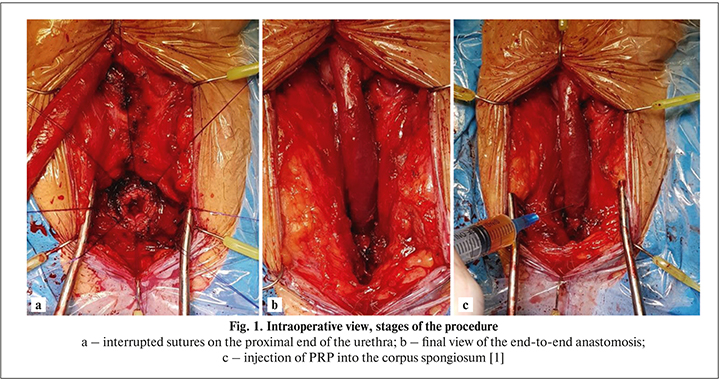
The main group included 30 patients. In the main group, patients underwent to the injection of PRP into the corpus spongiosum during surgical treatment (Fig. 1). In 17 (56.7%) patients, 2 to 3 DVIU or urethral dilation were previously done. In addition, five patients (16.7%) had previously undergone end-to-end urethroplasty, 4 (13.3%) correction of urethral plate after the first stage of urethroplasty, and 4 (13.3%) single-stage urethroplasty using the buccal mucosa.
The control group included 30 patients, who underwent the injection of saline into the corpus spongiosum intraoperatively. 24 (80%) patients had history of 2-3 DVIU or urethral dilation. Four patients (13.3%) had previously undergone end-to-end anastomotic urethroplasty, and 2 (6.7%) correction of urethral plate after the first stage of urethroplasty [1].
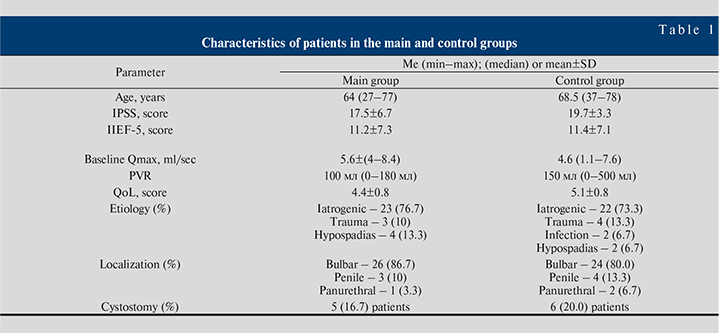
The characteristics of the patients of both groups are presented in table 1.
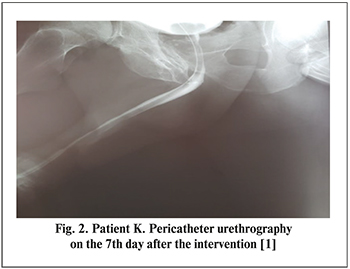
All patients underwent pericatheter urethrography on the 7th day (Fig. 2) after end-to-end urethroplasty, and on the 10th day after augmentation and multi-stage urethroplasty. In the absence of contrast extravasation, urethral catheter removal was accompanied by micturition cystourethrography, uroflowmetry, and assessment of post-void residual [1].
Statistical analysis was performed on an individual computer using Microsoft Excel spreadsheets and the Prism 6 for Windows v 6.04 software package (GraphPad Software, Inc). All history, clinical, laboratory, and instrumental data were entered into a Microsoft Excel database developed by the author and processed using the variation statistics. For each quantitative parameter, the mean value (M), standard deviation (δ), error of the mean (m), median (Me), 95% confidence interval were evaluated, while for qualitative data, frequency (%) was determined.
Results. The criterion of efficiency was the absence of the need for urethral dilation during one year of follow-up, a decrease in the maximum urine flow rate (Qmax) to less than 15 ml/s, the absence of voiding symptoms. The main criterion was the absence of the need for repeated surgical treatment or other manipulations (urethrocystoscopy using flexible cystoscope and urethral calibration were not considered) [1].
The efficiency in the main group was 93.3%. There were two relapses. In the control group, the efficiency was 76.7% (seven relapses) [1].
Also, in both groups, an analysis of the efficiency was carried out depending on the method of surgical treatment (table 2).
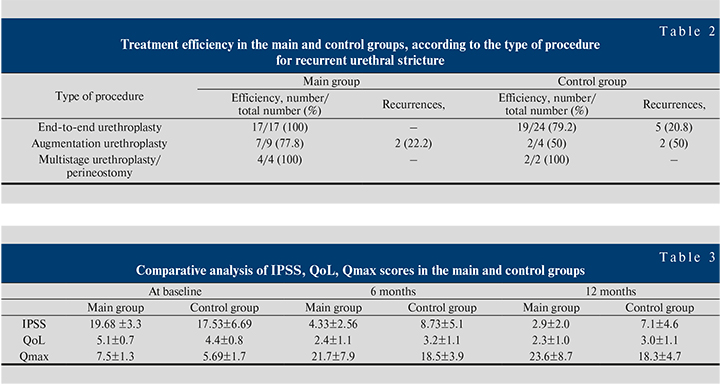
The average quality of life (QoL) score before surgery was significantly worse in the main group (p<0.05), which may be associated with the previous treatment. In the main group, more patients had previously had urethroplasty (table 3) [1].
The average preoperative Qmax value in both groups did not differ significantly (p>0.05). When comparing Qmax after urethroplasty, a significant difference was obtained at the 12th month (p<0.05) (table 3) [1].
The average duration of bladder drainage in the main group was 8.8±2.9 days, which was significantly less than in the control group (14.3±4.4 days; Student's coefficient, p<0.001). According to the statistical analysis, in the main group, relapses were associated with the duration of bladder catheterization (r=0.597; p<0.01). This fact confirms our hypothesis, that regenerative potential of PRP allows for earlier removal of the urethral catheter, reducing the incidence of infectious complications by 20% and thereby reducing the incidence of recurrence of urethral stricture [1].
Discussion. There is sufficient data on the efficiency of PRP in various fields of medicine, beginning from aesthetics to traumatology and maxillofacial surgery and reconstruction of complex purulent wounds [1, 7-9]. Many factors of platelets have various effects, some of which are still unknown. Well-studied are 7 factors that can stimulate cellular proliferation and angiogenesis [1, 10, 11]. Also, PRP stimulates the formation of endothelium, provides hemostasis, reduces pain, has an anti-inflammatory effect, reduces the risk of infectious complications and prevents postoperative complications [12]. In reconstructive urethral procedures, there are a small number of studies on the use of PRP. There are no studies at all dedicated tothetreatmentof recurrenturethral strictures in order to not only improve the outcomes, but also reduce the risk of relapse. E.G. Karpushchenko assessed the efficiency of substitution urethroplasty with a buccal graft depending on the use of PRP. The author obtained a 2-fold decrease in the recurrence rate [13].
Scarcia et al. used gel-like PRP in the form of a plate during urethroplasty using a buccal graft. Such procedure was performed in 10 patients. After 20 months of follow-up, no recurrence was noted [14].
Our results proved the efficiency of PRP (93.3% vs. 76.7% in main and control groups, respectively) [1].
In the main group, the efficiency of end-to-end urethroplasty was 100%, and there was no relapse. When using PRP during augmentation urethroplasty, the efficiency was 77.8%. Multi-stage urethroplasty using PRP showed high efficiency (100%). It should also be noted that the efficiency was higher for urethroplasty, when complete excision of scar tissue was done, since PRP has a stimulating effect on the healing process, but does not affect the pre-existing scar tissue and does not lyse it [1, 15].
The efficiency of end-to-end urethroplasty in the control group was 79.2%. There were 5 cases of relapse. The efficiency augmentation urethroplasty in the control group was lower than in the main group (50%). Multi-stage urethroplasty showed a high efficiency, which was comparable to the main group (100%).
The positive effect of PRP on regeneration and a decrease in the inflammatory response allows to lower risk of postoperative complications, which can also lead to a relapse.
Eryilmaz et al. used PRP for the treatment of penile shaft hypospadias in children and noted a decrease in rate of postoperative complications. When using PRP, fistulas occurred in 10%, relapse in 5% and infectious complications in 5% of patients, compared to 25%, 20% and 35% in the control group, respecti-vely [16].
Effective use of PRP in the treatment of recurrent urethral strictures improves treatment outcomes and reduces the recurrence rate. This result is facilitated by the stimulating effect on the processes of regeneration and angiogenesis, which accelerates tissue healing. In our work, we also found a reduction in the time of bladder catheterization, thereby reliably reducing the frequency of both stricture relapse and infectious complications, which also led to recurrence [1].
Conclusions. A combined approach to treatment (optimal surgical procedure + stimulation of regeneration by injection of PRP into the corpus spongiosum) allows to improve outcomes in patients with recurrent urethral stricture. In addition, this improves the physical condition of patients, increases emotional and mental health, and consequently positively affect quality of life.