

CiteScore
0.7
Scopus
Aim. To evaluate the microbial spectrum of urine before and after transurethral resection of prostate (TURP) in patients with postoperative infectious complications.Kogan M.I., Medvedev V.L., Naboka Yu.L., Ivanov S.N., Palaguta G.A., Arkhipenko M.V.
Introduction. Infectious complications of transurethral procedures for benign prostatic hyperplasia (BPH) represent a negative component of their safety profile [1]. The main cause for the development of infectious complications aside from altered reactivity of the macroorganism, which can be a result of medical manipulations and surgical aggression, is a change in the microbiota in general and the urinary system in particular [2, 3]. The assessment of the microbial factor of urine and urinary tract in the implementation of preventive measures with an assessment of the antibacterial resistance of microorganisms is of relevance. Understanding the changes of the microbial spectrum in physiologic conditions and under pathology is the most important component of an effective strategy for managing the risks of infectious complications, but the current standards of bacteriological examination of urine do not provide reliable and comprehensive information about the microbiota.
Aim. To evaluate the microbial spectrum of urine before and after transurethral surgery for BPH in patients with postoperative infectious complications.
Materials and methods. A single-center retrospective observational study was carried out from January 2016 to February 2023. Inclusion criteria were a presence of indications for surgical treatment of BPH, prostate volume of 30–80 cc, no history of sexually transmitted diseases and urinary tract infections at the time and at least 1 month before hospitalization, no history of antibacterial therapy at least 1 month prior to surgery, no prostate cancer, informed consent to participate in the study. The study included patients who underwent mono-or bipolar transurethral resection of the prostate (TURP) and who developed urinary tract and genital infections during hospitalization. Patients who were confirmed to have prostate cancer according to postoperative histological examination were excluded. If there were no significant bacteriuria (≥103 CFU/ml), patients received antibacterial prophylaxis with a single administration of second- or third-generation cephalosporins, inhibitor-protected aminopenicillins, or aminoglycosides for 1 hour prior to intervention. In case of significant bacteriuria at baseline, antimicrobial therapy was started 48 hours before surgery and the efficiency of the therapy was confirmed by repeated bacteriological examination of urine prior to intervention.
The antibacterial prophylaxis was stopped no later than 24 hours postoperatively. All patients with an elevated total PSA level (>4 ng/ml), as well as abnormalities at digital rectal examination or magnetic resonance imaging, underwent prostate biopsy at least 2 months before transurethral prostate surgery. Urine collection before surgery and in case of development of infectious complications, as well as bacteriological examination of urine, were performed in accordance with the Clinical Guidelines of the Russian Federation [4]. In the absence of urinary drainage, midstream urine was collected in a sterile Sterile Uricol container. In patients with cystostomy tube or a urethral catheter, the drainage was first replaced with subsequent urine collection. The results of the bacteriological study were confirmed by mass spectrometry using MALDI Biotyper 3.0 (Bruker Daltonics, USA). The significant bacteriuria was defined as ≥103 CFU/ml and significant leukocyturia as ≥10 per field. Statistical analysis was performed using statistical processing and visualization environment of IBM SPSS Statistics ver. 23.0.
Results
1) Sample characteristics
The study included 122 patients who developed postoperative infectious complications during hospitalization. The median age was 68 (63; 72) years. 21 (17.2%) men had cystostomy tube at baseline, while 101 (82.8%) patients had no drainage (p<0.05). Only in 3 (2.5%) cases, signs of infection developed earlier than 48 hours after intervention, while in the remaining 119 (97.5%) patients, the infectious process manifested later than the second postoperative day (p<0.05). Clinical manifestations included fever, symptoms of urinary tract infection, ascending pyelonephritis, as well as genital infection, the presence of ≥10 leukocytes per field in urine.
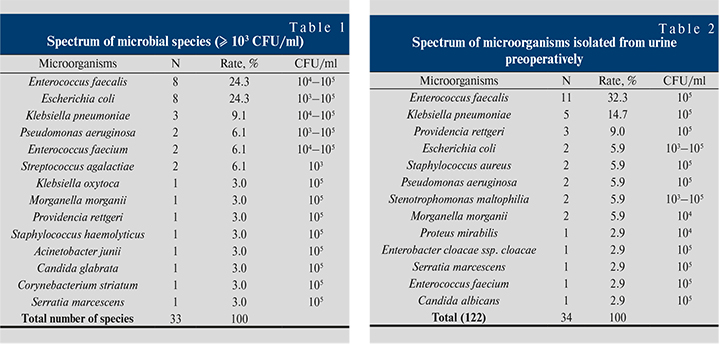
2) Preoperative spectrum of microorganisms detected in urine of patients with postoperative infectious complications Bacteriological examination of urine using standard media allowed to detect microorganisms at baseline only in 27 patients (22.1% of cases). Thus, 33 isolates and 95 negative results of urine culture were obtained. The spectrum of isolated microorganisms and CFU levels are presented in table 1. E. faecalis and representatives of Enterobacterales, including E. coli and K. pneumoniae were most often isolated from urine.
3) Microbial spectrum of urine in patients with infectious complications in the postoperative period
In vast majority of patients with postoperative infectious complications there was no bacteriuria ≥103 CFU/ml at baseline (76.2%). Only 29 (23.8%) men had bacteriuria ≥103 CFU/ml. The spectrum of urine microorganisms is presented in table 2. E. faecalis and Enterobacterales representatives (E. coli, K. pneumoniae, P. rettgeri) predominated in urine.
4) Comparison of pre- and postoperative bacteriuria in patients with infectious complications of transurethral prostate surgery
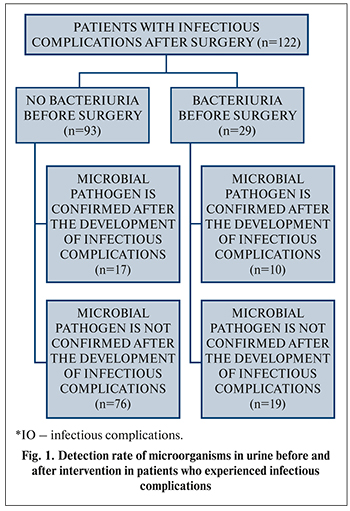
The results of the perioperative bacteriological study of urine in 122 patients with postoperative infectious complications are presented in Fig. 1. The absence of bacteriuria was noted in 19 (65.5%) of 29 patients who had a positive urine culture at baseline. Among 93patients without bacteriuria before the intervention, no microorganisms were isolated from urine in 76 (81.7%) cases. However, in 17 (18.3%) men, various taxa of microorganisms were detected.
Ten (8.2%) of 122 patients had bacteriuria both before and after the intervention. The results of this part of the study are presented in table 3.
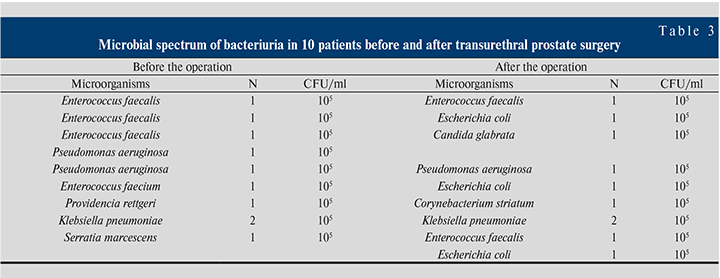
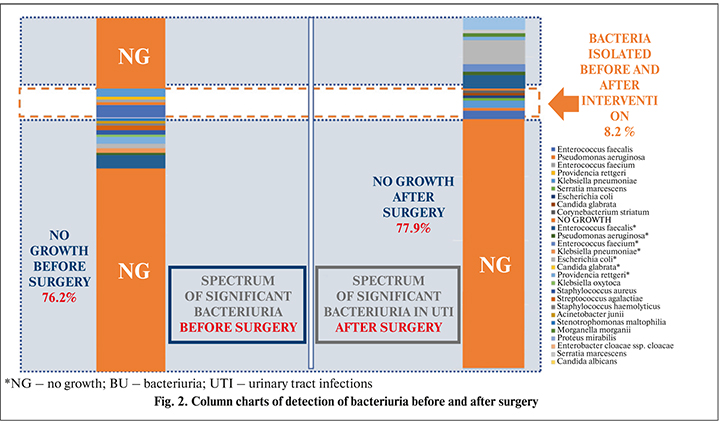
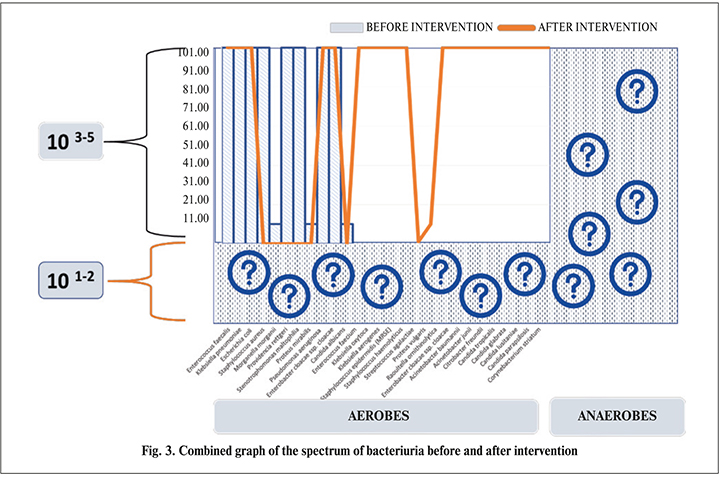
A comparative analysis of the pre- and postoperative bacterialspectruminpatientswithinfectiouscomplications demonstrates negative urine culture in 76.2% of cases before and in 77.9% cases after the intervention (Fig. 2). Of the 122 patients, 19 (15.6%) had significant bacteriuria only at baseline, which is 65.5% of the total number of men with initial bacteriuria (29 patients). In 17 (13.9%) of 122 patients with no bacteriuria at baseline, the microbial agent was isolated postoperatively, while in 76 (62.3%) of 122 patients, urine culture was negative both before and after intervention. Only in 4 of 10 patients with bacteriuria before and after surgery, the same microorganism was isolated, while in the remaining 6 cases, there was a change in the microbial spectrum. The combined graph (Fig. 3) of the preoperative bacteriuria spectrum and the postoperative microbial spectrum demonstrates the possibilities and key disadvantages of using standard media in bacteriological examination of urine. Thus, the existing standard allows assessing the aerobic cluster of microorganisms in concentrations of at least 103 CFU/ ml, while the dynamics of the anaerobic cluster, as well as the composition and changes in the microbial flora with concentrations below 103 CFU/ml, remain completely missed.
Discussion. Approaches to assessing the infectious factor in patients undergoing surgical treatment for BPH are not unified and therefore often do not provide a full understanding of the initial bacterial status of urine. Moreover, the assessment of preoperative leukocyturia is considered a criterion for excluding/presence of an infectious process. An analysis of data from more than 825 patients from 138 centers around the world (Europe, Africa, Asia, South America) demonstrated that the frequency of routine bacteriological testing of urine before transurethral prostate procedures is 59.2% [2]. There is no doubt that the growing burden of resistance to antibiotics and variability in microbial spectrum dictates the need for a more thorough assessment of the risks of developing infectious complications for effective treatment [5, 6].
Data from a number of studies indicate that preoperative bacteriuria may be an independent risk factor for the development of postoperative infectious complications [7]. According to reports, the frequency of significant bacteriuria before surgical treatment varies from 27.0 to 44.7% [8–13]. In most studies E. coli was the predominant pathogens, isolated in 10.0–20.0% of cases [10–14], and E. faecalis was found in 8.2–40.0% of cases [10, 14]. Among other microorganisms, S. aureus, K. pneumoniae, P. aeruginosa, as well as S. epidermidis, P. mirabilis, Citrobacter spp., K. oxytoca, A. baumannii, Providencia spp., S. marcencens, S. viridans are isolated from urine with varying frequencies [10–14]. These data are consistent with the microbial spectrum of urine in our study. However, it should be noted that there are no published data on the preoperative bacterial spectrum of urine among patients who developed infectious complications after transurethral procedures. These are the data presented in our study.
The bacterial spectrum of pathogens in patients who experience infectious complications after transurethral prostate surgery has been described by many authors. According to a survey of 400 patients, the urine microbiota included Coagulase-Negative Staphylococci (CNS), Enterococcus spp., E. coli, S. aureus, Proteus spp., Klebsiella spp., Pseudomonas spp., Streptococcus spp., Enterobacter spp., Serratia marcescens [15, 16]. In a later study of postoperative infectious complications of transurethral prostate surgery, carried out in 2016, M. Kikuchi et al. provide data on the dominance of E. faecalis and E. coli (≥ 104 CFU/ml) in urine of 190 patients with infectious complications, while E. cloacae, A. baumannii, MRSA, S. haemolyticus, S. caprae, Corynebacterium spp., S. epidermidis, S. hominis, P. aeruginosa, E. aerogenes were isolated in lower concentrations [10].
The microbial spectrum of urine, verified in patients with infectious complications, demonstrates that only 57.7% of isolates belong to the group of dominant uropathogens, while the rest of the spectrum (42.3%) is represented by minor taxa. Our data on the sequential assessment of the microbial spectrum of urine before and after transurethral procedure in patients with infectious complications, obtained using a standard bacteriological study, allow to present a perioperative bacterial status in a narrow range available for assessment using a standard set of nutrient media. On the other hand, areas that remain outside the standard assessment of the microbial composition of urine are key potential areas for studying the full dynamics of the bacterial status of urine.
Conclusion. Our results indicate an extremely low detection of bacterial agents in urine of patients with BPH who experienced infectious complications of transurethral procedures in cases of using standard bacteriological testing. In addition, the assessment of significant bacteriuria before surgery gives approximately the same ratio of negative and positive results of urine culture. Only a small proportion of men experience persistent bacteriuria, and the same microorganism is detected in less than half of them. Thus, the standard antibiotic prophylaxis and the preventive measures are partly effective in reducing a narrow spectrum of aerobic microorganisms detected before surgery using standard nutrient media, which, however, does not exclude the development of infectious complications. The microbial spectrum in lower concentrations, which remains outside the scope of the standard bacteriological analysis, as well as its anaerobic component, are potential areas of interest for studying intermicrobial interactions.