

CiteScore
0.7
Scopus
Introduction. Recurrence of non-muscle-invasive bladder cancer (NMIBC) occurs in 70% of cases, and the risk of progression to muscle-invasive bladder cancer is 20%. Intravesical BCG therapy is indicated in order to increase relapse-free survival in patients with intermediate and high-risk NMIBC. We carried out a survey of Russian urologists on the use of intravesical BCG therapy in the treatment of NMIBC, and also presented the regulatory framework for the use of BCG for the treatment of bladder cancer.Dymov A.M., Lee Yu.A., Korchagin M.P., Dzharimok A.R., Vinarov A.Z., Gazimiev M.A.
Introduction. Recurrence rate of non-muscle invasive bladder cancer (NMIBC) reaches 70%, and the risk of progression to muscle-invasive cancer is 20% [1]. According to the clinical guidelines, in order to increase recurrence-free survival, patients with intermediate and high-risk NMIBC are prescribed intravesical BCG therapy [2]. It is one of the most effective adjuvant treatment methods for these patients. A meta-analysis that included 9 studies and 2820 patients showed a 32% reduction in the risk of NMIBC recurrence with intravesical BCG therapy compared to a course of Mitomycin C instillations [3]. In 2020, the superiority of BCG therapy over Mitomycin C was confirmed by a Cochrane systematic review [4]. Higher efficacy of BCG therapy was noted in comparative studies with epirubicin
[5] and a combination of epirubicin with interferon [6]. In addition to a lower recurrence rate, the risk of NMIBC progression during BCG therapy was 27% lower than in the control group, which included intravesical
chemotherapy and other types of immunotherapies [7]. It is worth noting that BCG therapy is the only organ-preserving treatment indicated for patients with carcinoma in situ (CIS) [7]. According to the results of retrospective studies, a complete response in patients with CIS after BCG therapy was achieved in 75–87% of cases, compared to only 48% after chemotherapy [8, 9]. Definitely, in addition to proper adjuvant therapy strategy, the efficiency of NMIBC treatment also depends on the quality of the primary removal of a bladder tumor and on the immediate single instillation of a chemotherapy drug. However, the key role of both patient and physician adherence in the outcome of therapy should not be forgotten. A 2011 study showed low physicians' compliance with clinical guidelines for the treatment of NMIBC. Factors complicating the use of adjuvant therapy were the need to choose from several drugs and variability in the technique of the procedure itself. Despite the proven efficiency of BCG therapy, physician adherence to its administration was only 26% [10].
Definition of BCG therapy
BCG vaccines are a family of heterogeneous live attenuated vaccines. More than 14 BCG strains are used worldwide. A 2020 comparison of licensed BCG vaccines by Angelidou et al. demonstrated significant differences in the immunological response to the drug, namely in the level of induced cytokines, which must be taken into account when comparing the efficiency of BCG drugs [11]. In the Russian Federation, two vaccines, which are lyophilisates for the preparation of a suspension, are registered for intravesical therapy of NMIBC, including the Russian drug Imuron-vac based on the M. bovis BCG-1 substrain (M. bovis BCG-1, Russia) and the German drug Uro-BCG-medak based on the RIVM strain (Netherlands Vaccine Institute). According to the manufacturers, one vial of the Imuron-vac lyophilisate contains from 2.4x10⁸ to 4.5x10⁸ viable cells, while Uro-BCG-medak from 2x10⁸ to 8x10⁸ viable cells. Such a difference in the quantitative content of viable cells can affect the induced immune response and subsequently the efficiency of the therapy, which means that comparative clinical studies are needed.
Mechanism of action of BCG immunotherapy
The mechanism of triggering the immune response to the tumor remains unclear. Most likely, the principle of action of the BCG vaccine against bladder cancer is a complex of various direct and immune-mediated effects [12].
The action of BCG immunotherapy begins with the attachment of the drug molecules to the urothelium through physicochemical interaction with the damaged layer of glycosaminoglycans or by attachment to fibronectin through a ligand-receptor bond, which causes the penetration of BCG molecules mainly into tumor cells. As a result, both local and systemic immune responses are induced. Activation of antigen-presenting cells results in active secretion of cytokines and chemokines (IL-1β, IL-8, IL-15, IL-18, CXCL10, GM-CSF, CCL2 and CCL333), which are signaling molecules for immunocompetent cells [13]. The main role in the destruction of tumor cells belongs to CD4 and CD8 T lymphocytes, as well as NK cells. Cytotoxic T lymphocytes and NK cells are the main agents that destroy tumor cells during intravesical BCG immunotherapy [14].
The severity of the delayed hypersensitivity reaction can be assessed by a positive reaction to the Mantoux skin test with injection of two tuberculin units before BCG therapy. A positive reaction indicates the presence of T-cell immunity, and therefore, directly correlates with the intensity of the response to BCG immunotherapy [15]. In individuals previously vaccinated with BCG or with a history of tuberculosis infection, as well as active or latent tuberculosis infection, a better 5-year relapse-free survival was noted [16]
Aim. To assess the frequency of prescribing intravesical BCG therapy to patients with urothelial carcinoma of the bladder.
Results
The place of BCG therapy in the treatment of patients with NMIBC in Russia
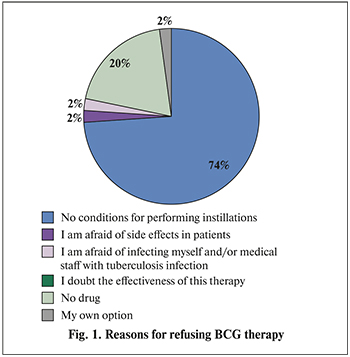
We carried out a survey of Russian urologists on the use of intravesical BCG therapy and associated difficulties, as well as a review of the regulatory framework in order to provide an algorithm of actions for a urologist regarding epidemiological safety when performing intravesical BCG therapy for oncological patients in healthcare facilities. The survey involved 145 physicians. Of them, 42% are certified urologists, 48% are urologists and oncologists, and 10% are only certified oncologists. Among the physicians treating NMIBC, 99 have over 10 years of experience, 27 have 5 to 10 years of experience, and 19 are young specialists with less than 5 years of experience. According to the survey, 46 (32%) of the 145 physicians do not prescribe BCG therapy to patients with NMIBC. Among them, the majority (63%) have over 10 years of experience. According to our data (Fig. 1), most physicians do not prescribe BCG therapy due to the lack of conditions for carrying out BCG therapy. At the same time, 87% of the respondents work in either oncology and urology hospitals or oncology dispensaries. It should be noted that the lack of conditions for BCG therapy was the leading reason not only for refusing to prescribe therapy, but also for referring patients to other healthcare facilities (81%). 68% (n=99) of respondents use BCG therapy for the treatment of patients with NMIBC. The most frequently prescribed drug is Imuron-vac (69%). 29% of respondents use Uro-BCG-medac, and 2% OncoTICE, which is not registered in the Russian Federation.
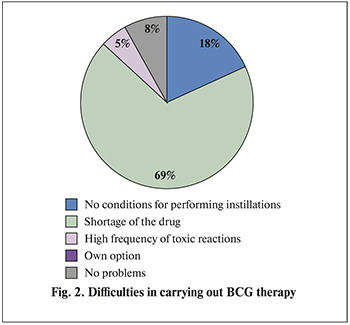
Only 8% of doctors who perform BCG therapy in their healthcare facilities do not report any difficulties (4% work in private medical centers, 4% in urological hospitals). Most often, doctors report a shortage of the drug (Fig. 2). Among the physicians who stated that they have the ability to perform BCG therapy in their healthcare facilities, 11% perform intravesical instillation on outpatient bases, 14% in oncology hospitals, 21% in oncology dispensaries, and 46% in urology hospitals.
Discussion
Sanitary and epidemiological requirements for BCG therapy
The survey showed that the most common reason for refusing BCG therapy is the belief of doctors in the absence of conditions for BCG therapy in their healthcare facilities, which is due to insufficient awareness of existing sanitary and epidemiological requirements.
According to the Federal Law of the Russian Federation of 04.05.2011 No. 99-FZ «On licensing of certain types of activities» (Chapter 2, paragraph 46; paragraph 19), there is no license required to carry out BCG therapy in a healthcare facility; the law permits the use of immunological drugs for therapeutic purposes.
Requirements for BCG therapy are presented in the sanitary and epidemiological requirements, guidelines, and instructions applied to the use and administration of the BCG vaccine, namely:
1. Order of the Russian Ministry of Health dated March 21, 2003 No. 109 «On improving anti-tuberculosis measures in the Russian Federation», Instructions for vaccination and revaccination against tuberculosis with BCG and BCG-M vaccines (Appendix No. 5).
2. Resolution of the Chief State Sanitary Doctor of the Russian Federation dated January 28, 2021 No. 4 on approval of sanitary rules and regulations SanPiN 3.3686-21 «Sanitary and Epidemiological Requirements for the Prevention of Infectious Diseases» (as amended on May 25, 2022).
3. Sanitary rules and regulations SanPiN 2.1.3684-21. Section X, «Waste Handling Requirements», paragraphs 157-266.
4. SanPiN 3.3686-21. Sanitary Rules and Norms «Sanitary and Epidemiological Requirements for the Prevention of Infectious Diseases», paragraphs 4200-4251.
5. SanPiN 3.3686-21. Sanitary Rules and Norms «Sanitary and Epidemiological Requirements for the Prevention of Infectious Diseases», paragraphs 4252–4378.
Procedure Room Requirements
According to sanitary and epidemiological requirements No. 3.3686-21, registered on 15.02.2021, intravesical
BCG instillation can be performed in a manipulation/ urology room, which must have:
Requirements for storage, transportation, accounting and destruction of BCG vaccine for intravesical immunotherapy
Requirements for the use of BCG vaccine for intravesical immunotherapy of bladder cancer
According to the order of the Ministry of Health of the Russian Federation dated March 21, 2003, No. 109 «On improving anti-tuberculosis measures in the Russian Federation», the procedure is carried out on strictly designated days and hours. Manipulations are not allowed in rooms, as well as by the same employees who are involved in the preparation of cytotoxic drugs for parenteral administration.
In order to ensure epidemiological safety in terms of tuberculosis, before prescribing intravesical immunotherapy, each patient undergoes:
The patient's medical chart should reflect:
To avoid contamination on the day of BCG immunotherapy, it is prohibited to carry out any other parenteral manipulations, including administering of drugs, taking blood, carrying out invasive examinations.
Requirements for organizing disinfection measures
According to the sanitary and epidemiological rules SanPiN No. 3.3686-21, medical devices, equipment, furniture, surfaces and class B medical waste, as well as cleaning equipment are subject to disinfection and pre-sterilization cleaning with solutions of disinfectants that have an antimicrobial effect against Mycobacterium tuberculosis.
Liquid class B waste and biological fluids of patients after intravesical BCG immunotherapy may be discharged without prior disinfection into the centralized sewage system. The spilled preparation is neutralized using a 5% chloramine solution. In accordance with SP 3.3.2.1120-02, waste and used materials can be disposed of by physical (steam sterilization under a pressure of 0.15 MPa at a temperature of 126±2°C for 90 min (SP 1.3.2322-08) or chemical (in a 5% chloramine solution for 6 hours) methods.
Requirements for the organization of work of medical personnel and conditions for compliance with safety precautions
It should be taken into account that medical workers with acute respiratory diseases or having open wounds on their hands, purulent lesions of the skin and mucous membranes regardless of their location, as well as those with immunosuppression, are excluded from procedures using the BCG vaccine.
If the drug gets on skin, it must be washed with a swab soaked in a 0.5% chloramine solution and then rinsed with warm water and soap.
Technique of BCG therapy
The standard algorithm includes:
1) The patient refrains from taking liquids for 4 hours before the procedure;
2) Emptying the bladder immediately before the procedure;
3) Introduction of the drug through a urethral catheter under low pressure;
4) Clamping the catheter for 2 hours;
5) Moving the patient during the procedure, either active or passive (turning the patient from supine to prone position and vice versa every 15 minutes);
6) Removing the urethral catheter;
7) Voluntary emptying of the bladder in a sitting position;
8) Refraining from taking liquids for 2 hours after the procedure;
9) Maintaining a state of hyperhydration for 48 hours after the procedure by increasing fluid intake.
In a retrospective study by Nagai et al., which included 173 patients, it was demonstrated that reducing the exposure time to 1 hour did not reduce the incidence of side effects and did not affect the recurrence rate [17]. Andius et al. reduced the exposure time of the drug to 30 min in the study of 51 patients, and showed a significant decrease in the incidence of side effects in those who had previously had significant adverse effects during BCG therapy [18].
Conclusion. The high efficacy of intravesical BCG therapy in the treatment of patients with intermediate-and high-risk NMIBC has been proven and is beyond doubt, but rates of recurrence and progression of bladder cancer in general population remain high. According to our survey, a third of doctors do not prescribe BCG therapy due to the lack of conditions for the procedure or a shortage of the drug. Consequently, the treatment of a third of patients with NMIBC does not fully comply with the guidelines, largely due to administrative and legal restrictions, which can often be overcome with a detailed study of the regulatory framework for the implementation of BCG therapy in healthcare facilities.