

CiteScore
0.7
Scopus
Introduction. Infectious and inflammatory diseases of the genitourinary tract account for approximately 42% of all outpatient urology cases, and disorders such as cystitis, pyelonephritis, and prostatitis are often characterized by a chronic, recurrent course. One of the key contributors to recurrent urinary tract infections is inappropriate therapy that does not take into account the local microbial spectrum and pathogen resistance profiles.Kulchavenya E.V., Rafalskiy V.V.
Introduction. Urinary tract infections (UTIs) are the most common bacterial infections and affect at least one million people worldwide each year [1–4]. Among noso-comial infections, UTIs rank second only to upper respi-ratory tract infections, which account for 24% in devel-oping countries [5]. UTIs have been shown to adversely affect mental health and quality of life [6].
Unfortunately, UTIs are associated with a high recur-rence rate [1]. Women are at higher risk of develop-ing UTIs than men; within six months, recurrence occurs in one in five women [7–8]. Chronic UTI increases the likelihood of gestational pyelonephritis [9]. Postmenopausal women are more prone to recurrent UTIs because lower estrogen levels lead to unfavorable changes in the urogenital epithelium and the urogenital microbiome [10].
UTIs are caused by a wide range of pathogens, includ-ing Gram-negative and Gram-positive bacteria, as well as fungi. Uropathogenic E. coli (UPEC) is the prin-cipal etiological agent of UTIs, accounting for about 75% of uncomplicated UTI cases; however, less com-mon pathogens such as Klebsiella pneumoniae (K. pneu-moniae), Staphylococcus saprophyticus (S. saprophyticus), Enterococcus faecalis (E. faecalis), group B Streptococcus (GBS), Proteus mirabilis (P. mirabilis), Pseudomonas aeruginosa (P. aeruginosa), Staƒphylococcus aureus (S. aureus), and other microorganisms cause opportu-nistic UTIs [1].
UPEC is responsible for complicated UTIs in at least half of cases [2]. The insufficient efficacy of initial anti-bacterial therapy for UTIs and the subsequent devel-opment of conditions favoring recurrence are largely explained by pathogen evolution, particularly the devel-opment of antimicrobial resistance.
Aim. To determine the spectrum of uropathogens and their antimicrobial resistance in cystitis, pyelonephritis, and prostatitis.
Materials and methods. The results of microbiological urine studies from urology outpatients performed by the Invitro laboratory network (https://www.invitro.ru/) over a three-year period (2022–2024) were analyzed. A total of 4031 bacterial isolates were evaluated: 2903 (72.0%) strains were obtained from patients with acute cystitis or chronic cystitis during exacerbation, 1017 strains (25.2%) from patients with acute pyelonephritis or chronic pyelo-nephritis during exacerbation, and 111 strains (2.8%) from patients with chronic bacterial prostatitis.
The study included patients residing in the Siberian Federal District (Altai Republic, Altai Krai, Irkutsk Region, Kemerovo Region, Krasnoyarsk Krai, Novosibirsk Region, Omsk Region, Tomsk Region, Republic of Tyva, Republic of Khakassia) during the period from January 1, 2022 to December 31, 2024. All urine samples were taken at the outpatient basis. Midstream urine samples were collected at any time of day, 2–3 hours after the previ-ous voiding; in patients with prostatitis, urine was col-lected after prostatic massage. To avoid contamination, genital hygiene procedures were observed. Samples were collected in sterile plastic Uri-swab transport containers (COPAN Diagnostics Inc.) and delivered to local offices and laboratories of the commercial Invitro network within two hours after voiding at ambient temperature. When prompt delivery of urine samples to the laboratory was not possible, they were refrigerated at +5° C for no longer than 24 hours. Samples with a bacterial load ≥104 CFU/ mL underwent pathogen identification followed by anti-microbial susceptibility testing. Preanalytical processing of clinical samples was performed using the automated WASP processor (COPAN, Italy). E-swab tubes were processed using the WASP system (standard culture and preparation of microscopy slides with Gram staining). Standard culture was performed using the four-quadrant streak method with the WASP system on CLED agar (bioMerieux, France) or Columbia agar with 5% sheep blood (Becton Dickinson, USA). Microorganism iden-tification was carried out by a semi-automated method using the VITEK2 system (bioMerieux, France) and MALDI Biotyper Microflex (Bruker Daltonik GmbH, Germany). Antimicrobial susceptibility was determined by an automated method using the VITEK2 analyzer (bioMerieux, France) in accordance with the manufac-turer’s recommendations. For quality control, internal and external quality assurance procedures were performed at least twice a year. External quality control was car-ried out using the procedures of the Center for External Quality Control of Clinical Laboratory Investigations (FSVOK, Russian Federation, www.fsvok.ru). As part of internal quality control, at least once a month, reference strains were used for pathogen identification and antimi-crobial susceptibility testing.
The raw laboratory data were exported from the labo-ratory information system in CSV format and processed using proprietary software for subsequent analysis. The transformed data were stored as two-dimensional tables and analyzed by creating appropriate queries written in the Python programming language. Relevant patents were obtained for the original algorithm for data transformation and analysis, the software, and the databases containing the processed information.
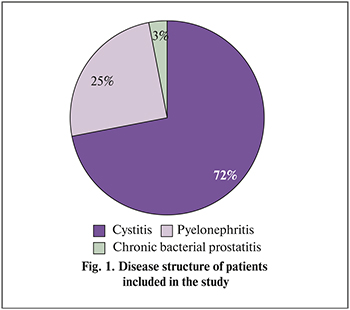
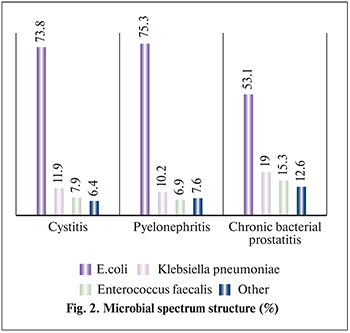
Results. The distribution of nosologies is presented in Figure 1. The structure of the microbial landscape differed depending on the diagnosis. E. coli was the predominant pathogen in all groups; however, while in cystitis and pyelonephritis it was detected in 73.8 and 75.3%, respectively, in patients with chronic prostati-tis the detection rate of E. coli was 53.1%. The growth of Klebsiella pneumoniae and Enterococcus faecalis was more frequently observed in prostatitis, at 19.0 and 15.3%, respectively, whereas in urinary tract infections the frequency of identification of these pathogens ranged from 6.9 to 11.9%. The “other” group included Proteus mirabilis, Streptococcus agalactiae, Enterobacter cloa-cae, and Pseudomonas aeruginosa. Their proportion in the microbial landscape ranged from 0.7 to 6.3%; overall, “other microorganisms” were identified in 6.4% of cases of cystitis, 7.6% of pyelonephritis, and 12.6% of chronic prostatitis. The spectrum of uropathogens by nosology is presented in Figure 2.
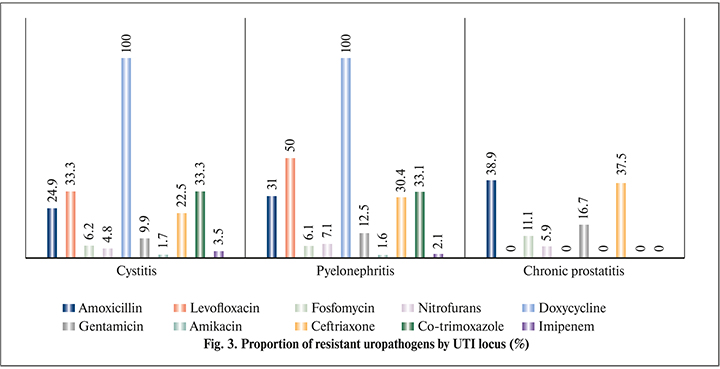
Resistance of the pathogenic microflora was assessed for E. coli. The proportion of E. coli strains resistant to amoxicillin/clavulanate was 24.9% in cystitis, 31.0% in pyelonephritis, and 38.9% in prostatitis. Every third E. coli strain isolated from a patient with cystitis was resistant to levofloxacin, as was every second strain in pyelonephritis; however, in prostatitis all E. coli strains were susceptible to this antibiotic. In prostatitis, E. coli resistance to co-trimoxazole was twice as high as that observed in cystitis and pyelonephritis. These results are illustrated in Figure 3.
Discussion. Antibiotics and antimicrobial chemothera-peutic agents have been used to treat UTIs since the introduction of sulfonamides in the 1940s, and this class of drugs remains the most commonly recommended therapeutic option for UTIs [1]. Efforts should be made to minimize the development of resistance by adhering to recommended treatment courses and dosages [11]. According to recent studies, older adults are at increased risk of UTIs caused by multidrug-resistant pathogens [12]. The use of empirical antibiotics should be limited to cases in which symptoms are pronounced and/or there is concern about a more serious infection [13]. When select-ing an antibiotic, local resistance patterns of uropatho-gens should be taken into account [14].
There is no convincing evidence supporting the use of antibiotic prophylaxis for recurrent UTIs; on the contrary, increasing evidence supports non-antibiotic preventive regimens for recurrent UTIs [15]. The 2025 European Association of Urology guidelines state that alternative methods of prevention and treatment have reduced antibiotic use for UTIs by 63% [16]. Since exces-sive antibiotic use is the main driver of the emergence of multidrug-resistant bacteria, and because about 25% of all antibiotic prescriptions are issued for UTIs, antibiotic prophylaxis should be used only after all non-antibiotic treatment options have been exhausted [17]. Recent stud-ies have demonstrated the potential of bacteriophage therapy for the treatment of urinary tract infections caused by multidrug-resistant bacteria such as E. coli and K. pneumoniae [18]. However, although the preliminary data obtained with this therapy are highly promising, substantial preclinical and clinical work is still required before bacteriophages can become an alternative to anti-biotics in the future. The results of our study showed that knowledge of antimicrobial susceptibility of uropathogens in a specific region may also be insufficient; fluctuations in microbial resistance depending on the site of inflam-mation should also be taken into account. Antimicrobial resistance of uropathogens is continuously monitored worldwide, including in different patient categories [19–26]. In the Russian Federation, the large-scale DARMIS study is conducted regularly [27–29]; however, previous investigators examined the characteristics of uropatho-gens depending on the region, whereas we determined the spectrum and resistance of pathogens depending on the site of inflammation.
Conclusion. Thus, urinary tract infection is caused predominantly by E. coli, whereas in prostatitis the spec-trum of pathogens is more diverse and the proportion of E. coli is 53.1%. Antimicrobial resistance of pathogens differs substantially between urinary tract infections and prostatitis, but regardless of the diagnosis, it is highest to amoxicillin/clavulanate and lowest to nitrofurans and fosfomycin.