

CiteScore
0.7
Scopus
Introduction. Recurrent chronic bacterial prostatitis (rCBP) is a hard-to diagnosis-and-treat disease which there is no consensus. A particularly difficult cohort is represented by patients who had COVID-19. The study aimed to evaluate the taxonomic structure and sensitivity to antibacterial drugs of microorganisms verified in expressed prostate secretion (EPS) in rCBP-patients who had COVID-19.Ibishev К.S., Naboka Yu. L., Ismailov R. S., Gudima I.A., Prokop Y.O., Vlasenko V.A, Kogan M.I.
Introduction. Currently, there is no consensus in diagnosis and treatment of chronic recurrent bacterial prostatitis [1–3]. This is due to the multifaceted pathogenesis of the disease with the development of hemodynamic, neuroendocrine, immunological and other changes in the prostate [4, 5]. Patients with chronic recurrent bacterial prostatitis often have polymorphic clinical manifestations, which may be accompanied by pain of various localizations (in the perineum, suprapubic, inguinal areas, etc.), often during or after ejaculation. A number of patients (30.0–45.0%) report lower urinary tract symptoms, various sexual disorders, as well as depressive symptoms [6, 7].
Etiologic therapy for chronic recurrent bacterial prostatitis is primarily aimed at the bacterial component. Therefore, according to the guidelines of the Russian Society of Urology (RSU) and the European Association of Urology (EAU), certain antibacterial drugs are the first line of therapy [8].
The efficiency of antibacterial therapy depends on several components, including an activity of the drug against typical/atypical pathogens, good safety and bioavailability, its pharmacokinetic characteristics, as well as the ability to achieve optimal concentrations in the tissue and prostatic secretions [9, 10]. For the latter point, an important characteristic of antibiotic is its lipophilicity and high acid dissociation constant. As a consequence, a number of antibiotics for the treatment of chronic recurrent bacterial prostatitis is quite low and includes fluoroquinolones, in some cases trimethoprim and macrolides [11–14]. However, given the polymorphism of the clinical manifestations, antibacterial therapy alone is less effective than the use of a multimodal treatment, including also α-blockers, antioxidants, anti-inflammatory drugs, immunoactive and phytotherapeutic drugs, etc. [3].
However, certain difficulties in the antibacterial therapy in chronic recurrent bacterial prostatitis are in the context of the global problem of multidrug resistance, which has worsened during COVID-19 pandemic [15]. Therefore, despite the use of modern diagnostic methods, strict adherence to the RSU and EAU guidelines on examination and treatment, the percentage of its relapses remains high [16, 17]. The increase in antibiotic resistance of uropathogens is also due to the irrationally widespread and active use of antibacterial drugs for infections that do not require their use not only in urological practice, but also in other medical specialties. Antibacterial therapy for chronic recurrent bacterial prostatitis, especially in patients who have had COVID-19, is often ineffective, which dictates the need for the development and use of other alternative treatment methods [18].
Aim. To study the taxonomic structure and sensitivity to antibacterial drugs of microorganisms verified in the expressed prostatic secretions (EPS) of patients with chronic recurrent bacterial prostatitis who have had COVID-19.
Materials and methods. A multicenter prospective randomized study out including 52 patients with chronic recurrent bacterial prostatitis who previously had COVID-19, was carried. All patients signed informed consent to participate in the study and publish personal data.
Inclusion criteria: age over 18 years, previous history of COVID-19, clinically and laboratory confirmed diagnosis of chronic recurrent bacterial prostatitis.
Non-inclusion criteria: presence of sexually transmitted infections, other prostate diseases (benign hyperplasia, cancer), infectious and inflammatory diseases of the urinary tract and reproductive organs (vesiculitis, urethritis, pyelonephritis); primary or secondary immunodeficiency, bladder outlet obstruction (urethral stricture, bladder neck sclerosis, urolithiasis, neurogenic lower urinary tract dysfunction, etc.), abnormalities of the urinary tract and reproductive organs, past or present oncological diseases of the urinary and reproductive organs; concomitant cardiovascular, neurological, endocrine, systemic and other disorders that could affect the results of the study; an episode of taking antibacterial or other drugs with antibacterial, prostate-protective, anti-inflammatory, immunostimulating properties within 30 days before inclusion in the study.
The average age of patients was 34.8 (29.4–40.5) years, the average duration of the disease was 5.7 (3.2–8.1) years.
In all patients, EPS was taken for bacteriological examination, followed by inoculation on special media for aerobic and anaerobic microorganisms (HiMedia), respectively, in aerobic (at 37°C, 24 hours) and anaerobic (AnaeroHiGas Pak, at 37°C, 48–72 h) conditions. Identification of pathogens isolated from EPS was carried out according to standard methods. When determining antibiotic sensitivity, the relevant recommendations were followed [19].
The study was carried out as part of the scientific work “Assessment of the influence of SARS-COV-2 on the reproductive potential of men with idiopathic infertility” (approved by the Scientific Local Ethical Committee of the Rostov State Medical University, Ministry of Health of the Russian Federation on October 22, 2021). The work was done in accordance with the provisions of the Declaration of Helsinki (revised in Fortaleza, Brazil, October 2013).
Statistical analysis was carried out using the application package IBM® SPSS Statistics 26.0 (“SPSS: An IBM Company”, IBM SPSS Corp., Armonk, NY, USA). Descriptive statistics included calculation of detection rates (%), mean (M) and standard deviation (±SD).
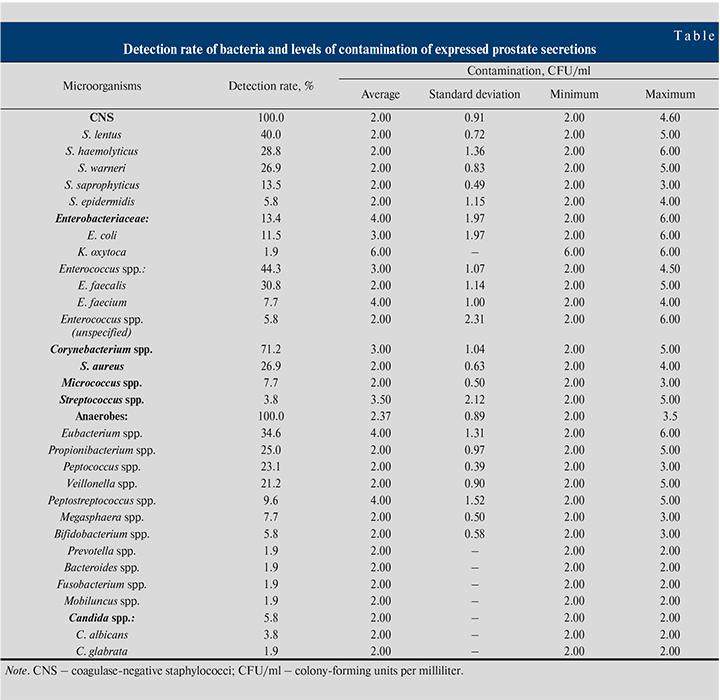
Results. The average age of the patients was 34.8±5.2 years, the duration of chronic recurrent bacterial prostatitis was 5.7±2.3 years. In all cases, various aerobic-anaerobic combinations microorganisms in EPS were recorded. A total of 27 species were identified. The aerobic pathogens were represented by 16 types and/or species, while anaerobic agents by 11. Among aerobic bacteria (see table), coagulase-negative staphylococcus species (CNS) were documented in all cases, represented by five species with a predominance of Staphylococcus lentus (40.0%), as well as Corynebacterium spp. (71.2%). The spectrum of isolated causative pathogens included Enterococcus spp. (44.3%), Staphylococcus aureus (26.9%) and Enterobacteriaceae (13.4%). In the anaerobic microbiota Eubacterium spp. were predominated (34.6%). The concentration of bacteria in EPS ranged from 102 to 106 CFU/ml. A level of 103 CFU/ml was recorded for 7 (25.9%) pathogens. However, for 21 (77.8%) species, in some cases, the concentration in EPS ranged from >103 to 106 CFU/ml.
The sensitivity to antibiotics of predominant aerobic strains isolated from EPS was studied. In descending order, the strains were represented by the following genera and/or species: Corynebacterium spp. (n=37), S. lentus (n=21), Enterococcus faecalis (n=16), S. aureus (n=15), Staphylococcus warneri (n=15), Escherichia coli (n=6).
E. coli was isolated from EPS only in 11.5% of cases, but since their role is generally proven in the etiology of the disease, its sensitivity to antibiotics was also studied.
For chronic recurrent bacterial prostatitis, the recommended drugs are levofloxacin or ciprofloxacin. We assessed the sensitivity of isolated microorganisms not only to the recommended fluoroquinolones, but also to other tablet drugs of various groups (macrolides, penicillins with β-lactamase inhibitors, tetracyclines, cephalosporins, etc.) in order to objectify the problem of multidrug resistance in a cohort of patients who had COVID-19 and repeatedly received different drugs, but not for relapse of chronic recurrent bacterial prostatitis (Fig. 1).
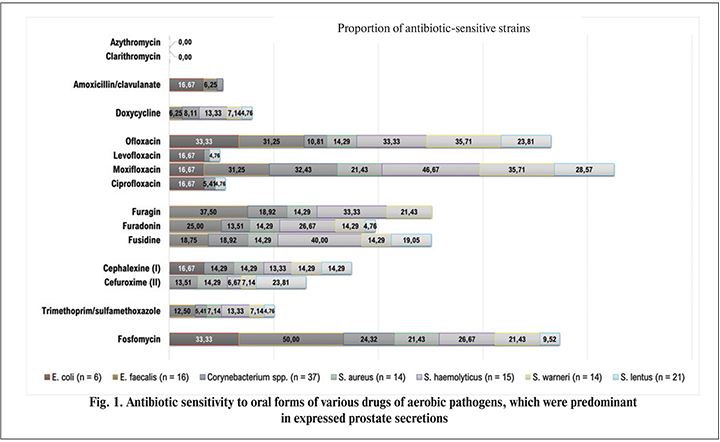
In this cohort of patients, catastrophically low sensitivity of a wide range of antibiotics, including recommended ones, was found. In total, the highest sensitivity of the identified aerobic pathogens was seen to only two drugs from the group of fluoroquinolones, namely moxifloxacin and ofloxacin, as well as fosfomycin.
Despite the good sensitivity to moxifloxacin, we are convinced that it should not be used in routine outpatient practice, but should be a “reserve” antibiotic.
Of the six E. coli strains isolated from EPS, only one (16.67%) was sensitive to levofloxacin and ciprofloxacin. Of the 15 tableted drugs, only three (ofloxacin, moxifloxacin, fosfomycin) had minimal activity against the dominant aerobic pathogen in EPS. he maximum sensitivity (50.0%) was observed for E. faecalis to fosfomycin.
Paradoxically, macrolides, which are traditionally used in the treatment of infections of the reproductive organs, were completely ineffective, since none of pathogens demonstrated sensitivity.
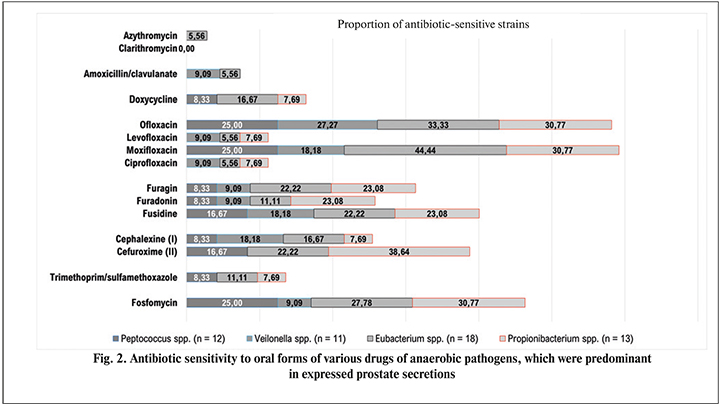
Of the anaerobic pathogens, the following species were predominated in EPS: Eubacterium spp. (n=18), Propionibacterium spp. (n=13), Peptococcus spp. (n=12), and Veillonella spp. (n=11). There is practically no data on the activity of the studied oral forms of drugs against a broad spectrum of non-clostridial anaerobic bacteria, with the exception of some fluoroquinolones.
In particular, 30.8% of Propionibacterium spp. strains isolated from EPS were sensitive to ofloxacin and moxifloxacin, 25.0% of Peptococcus spp. to moxifloxacin.
Susceptibility to levofloxacin was drastically minimal and distributed as follows: Peptococcus spp. (9.1%), Propionibacterium spp. (7.7%), Eubacterium spp. (5.6%) (Fig. 2).
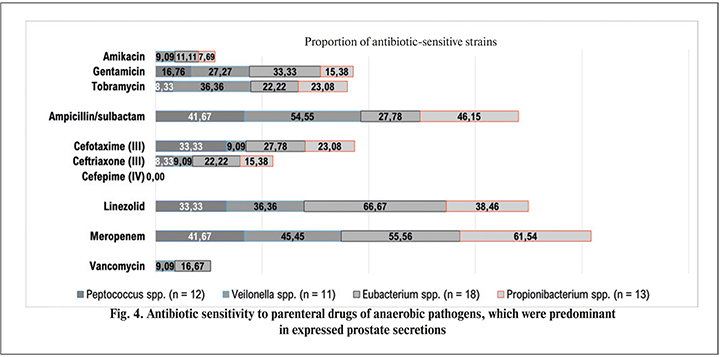
When analyzing the sensitivity to antibiotic therapy of the aerobic species dominant in EPS, there was a trend of multidrug resistance to parenteral drugs of six different groups, similar to oral forms. From the group of aminoglycosides, 66.7% of E. coli strains were sensitive to gentamicin and tobramycin. The highest sensitivity rate (56.25%) to amikacin/sulbactam was observed for E. faecalis (Fig. 3).
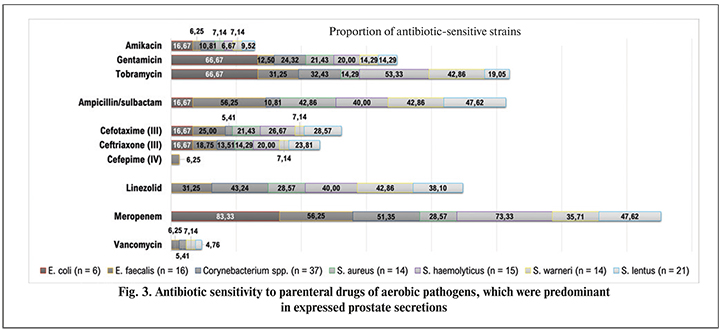
Cephalosporins of the third- and four-generations were characterized by minimal efficacy. About 40.0% of Corynebacterium spp., S. haemolyticus, and S. warneri strains isolated from EPS were sensitive to linezolid.For the dominant anaerobic pathogen in EPS, the most effective drug was meropenem with the maximum (61.54%) sensitivity for Propionibacterium spp. (Fig. 4).
Discussion. Patients with chronic recurrent bacterial prostatitis represent a special cohort for treatment, and those who have had COVID-19 and received antibiotics of various groups are an extremely difficult subgroup.
In the context of antibiotic resistance, therapy for patients not only with this pathology, but also with a number of other disorders, the etiology of which is based on the bacterial component, apparently can be divided into pre- and post-Covid stages. It is confirmed by our data on multidrug resistance of the dominant pathogen in EPS. We do not extrapolate these results to other centers, but only discuss the specific cohort of patients. Following the national guidelines, the drugs of choice for chronic bacterial prostatitis are levofloxacin and ciprofloxacin. In our previous publication [17], we already pointed out the low sensitivity rates to these drugs not only of Enterobacteria spp., but also of enterococci and CNS. In this work, we noted a catastrophic decrease in sensitivity compared to the previously described level. The data obtained are not align to results of a number of authors on antibiotic resistance, in particular in terms of fluoroquinolones [6, 18]. In our cohort of patients, there is not even a dilemma about the use of oral cephalosporins, which in case of the presence of strains with pan-resistance to traditional antibiotics, can be prescribed if there is confirmed sensitivity as step-down therapy [20]. More than 10 years ago, V. Lipsky et al. [21] showed that cefixime accumulates in the prostate similar to ciprofloxacin.
A previous study found that combination antibacterial therapy is preferable for multidrug-resistant mixed infections. At the same time, fluoroquinolones in combination with cephalosporins are the most effective against the majority of associates isolated in EPS of patients with chronic recurrent bacterial prostatitis, represented by both aerobes and anaerobes [10].
It can take quite a long time to discuss all data on sensitivity of various pathogens to antibiotics in order to recommend therapy for chronic recurrent bacterial prostatitis, but it must be remembered that they were carried out in the pre-pandemic period [22].
An absolutely logical question arises, why are we observing such a fatal situation? The answer lies on the surface. All 52 patients included in this study had confirmed COVID-19, including two times in 27 (51.9%) and three times in 16 (30.8%). Absolutely all patients received not only fluoroquinolones, but also other antibiotics. Therefore, for those with chronic recurrent bacterial prostatitis who have had COVID-19, it is quite difficult to choose monotherapy or combination of drugs in the context of not only typical, but also disputable pathogens. Moreover, chronic recurrent bacterial prostatitis is a disease, which is caused, as a rule, not only by one microorganism, but their associations.
Empiric therapy, aimed, for example, at one microorganism (enterobacteria, enterococci, etc.), will not change the situation as a whole for some patients, since the inflammatory process in the prostate can be supported initially by minor pathogen. In addition, a rate of their detection can increase with the elimination of one or more species from the bacterial association. The underestimation of the importance of bacterial associations is also indicated M.A. Mulvey et al. in his monograph “Urinary tract infection” (2017) [23].
Conclusions. Thetaxonomicstructureofmicroorganisms in EPS of patients with chronic recurrent prostatitis who had COVID-19 was characterized by complex and new variants of aerobic-anaerobic associations. When studying the antibiotic sensitivity, multi-resistant and pan-resistant bacteria were identified, which pose a significant threat due to the impossibility of appropriate therapy.