

CiteScore
0.7
Scopus
Introduction. Vaginal reconstructive surgery aims to correct pelvic dysfunctions, but some patients may experience new symptoms after the procedure. These patients may develop a negative attitude toward treatment. The available literature is ambiguous due to the use of different study samples, instruments, and insufficient follow-up periods for this patient group.Ausheva B.Kh., Kasyan G.R., Pushkar D.Yu.
Introduction. Pelvic floor disorders are a common problem worldwide and significantly reduce patients’ quality of life. According to the study by Hafidh B.A. et al. (2013), the incidence of de novo pelvic floor disorders ranges from 4 to 51% [1]. Vaginal reconstructive surgery is aimed at treating these disorders. However, in some patients, newly developed symptoms (de novo) are recorded after surgical procedures. In such cases, patients develop a negative attitude toward treatment. The literature data are contradictory, which is associated with the study of heterogeneous cohorts, the use of different assessment tools, and insufficient follow-up duration in this group of patients. There are many tools for assessing pelvic floor disorders, in particular validated questionnaires, the use of which helps medical personnel [1].
During our study, the following questions were studied: can we identify a combination of preoperative factors that accurately predicts the overall risk of developing new symptoms of pelvic floor disorders after surgery? Do preoperative assessments of symptom severity using ICIQ-SF (International Consultation on Incontinence Questionnaire Short Form), PFDI-20 (Pelvic Floor Distress Inventory), PFIQ-7 (Pelvic Floor Impact Questionnaire), and PISQ-12 (Pelvic Organ Prolapse/Urinary Incontinence Sexual Questionnaire) allow prediction of the development of specific new symptoms of pelvic floor disorders, for example, bowel symptoms, bladder symptoms, or pelvic organ prolapse symptoms after surgery?
Further research in this area is needed for a better understanding of the causes and mechanisms of de novo pelvic floor disorders, as well as for the development of methods for their prevention and correction.
Aim. To identify predictors of de novo pelvic floor disorders after vaginal reconstructive surgery during 12 months of follow-up.
Materials and methods. A prospective cohort study involving 159 patients admitted for surgical treatment of pelvic floor disorders (pelvic organ prolapse, urinary incontinence) from March to October 2023 was carried out. Of these, three patients refused surgical treatment after completing the questionnaires. Inclusion criterion was patients with symptomatic pelvic organ prolapse and urinary incontinence in the absence of an effect from conservative therapy. Exclusion criteria were patients who refused surgery during the study and those who did not attend the follow-up visit. Non-inclusion criteria were pregnant women, neurogenic bladder dysfunction, a history of radiotherapy, urgency urinary incontinence, and women with genital prolapse POP-Q <2 (POP-Quantification system). Before surgery, patients completed the validated questionnaires ICIQ-SF (International Consultation on Incontinence Questionnaire Short Form), PFDI-20 (Pelvic Floor Distress Inventory), PFIQ-7 (Pelvic Floor Impact Questionnaire), and PISQ-12 (Pelvic Organ Prolapse/Urinary Incontinence Sexual Questionnaire). After surgical correction, patients were invited for repeat visits at 3, 6, and 12 months to assess the postoperative condition by repeated completion of the questionnaire.
The study was approved by the Ethics Committee of the Russian University of Medicine (Protocol No. 04-23 dated April 13, 2023). The participants signed informed voluntary consent to participate in the study. Statistical data processing was performed using the Jamovi 1.8.3 statistical package, as well as Excel (product code: 00334-38920-77957-AA497). Logistic regression analysis was used to identify predictors of de novo pelvic floor disorders (urinary incontinence and pelvic organ prolapse). For significant predictors, an ROC curve and a plot showing the relationship between event probability and predictor value were constructed.
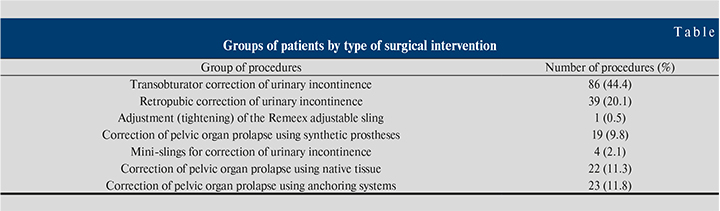
Results. The mean age of the patients was 56.3±12 years, and the mean body mass index (BMI) was 28.6±5.12. Stress urinary incontinence was diagnosed in 77 patients (48%), and mixed urinary incontinence in 60 patients (38%). Pelvic organ prolapse of varying severity was diagnosed in 32 of 159 patients (20%). The mean parity was 2. Perineal tears during childbirth were present in 55.9% of patients. A total of 194 surgical procedures were performed. Twenty-three patients (14%) underwent more than one surgical procedure. All surgical procedures were performed by one experienced physician. The types of procedures performed are presented in the Table.
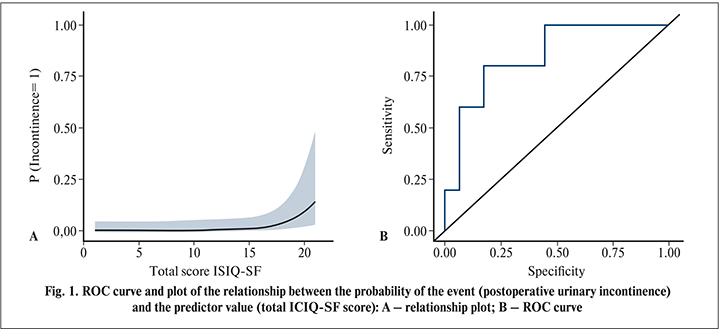
After surgical treatment, the patients were invited for follow-up visits at 3, 6, and 12 months and were asked to complete the same questionnaires again. De novo stress urinary incontinence was recorded in 5 patients during follow-up, and pelvic organ prolapse of varying severity in 10 patients. According to our study, the prevalence of de novo pelvic floor disorders in women after vaginal urogynecological surgery was 9.7%. Analysis of data from three questionnaires (ICIQ-SF, PFDI-20, and PFIQ-7) showed that a higher ICIQ-SF score was a statistically significant predictor of postoperative stress urinary incontinence (p=0.045; OR 1.62; 95% CI 1.01–2.59). However, the increase in risk was moderate: at a score close to 20, the probability of urinary incontinence increased by 25% compared with patients with minimal scores (Fig. 1).
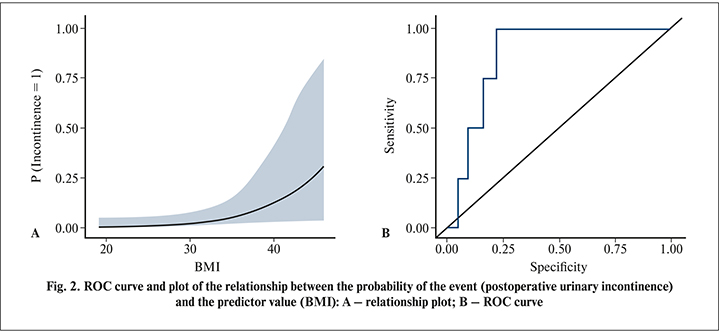
When risk factors such as parity, age, and BMI were analyzed, higher BMI (p=0.042; OR 1.21; 95% CI 1.01–1.46) was found to increase the likelihood of postoperative urinary incontinence (Fig. 2).
It should be noted that all patients with postoperative urinary incontinence had undergone procedures for urinary incontinence via the transobturator approach. At the same time, there was no significant association between the type of surgery and the presence of postoperative urinary incontinence, which may be related to the small number of patients with postoperative urinary incontinence.
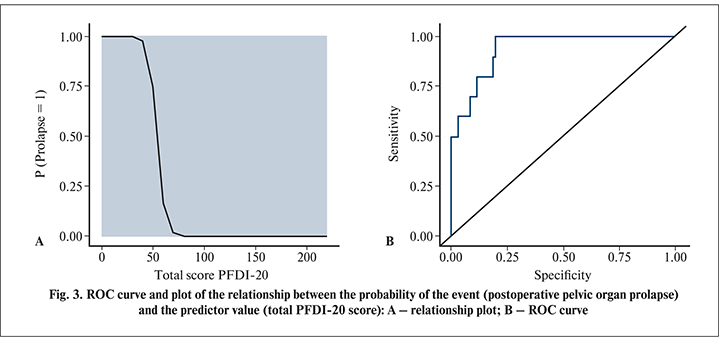
A predictor of pelvic organ prolapse was the preoperative PFDI-20 score (p=0.014; OR 0.77; 95% CI 0.62–0.95).
At the same time, a significantly lower questionnaire score was associated with the development/recurrence of pelvic organ prolapse (Fig. 3).
Patients with postoperative pelvic organ prolapse underwent different types of procedures: native tissue repair, repair using synthetic prostheses, and repair using anchoring systems. The type of surgery was not a statistically significant factor for the occurrence of postoperative pelvic organ prolapse.
Discussion. The present study was aimed at identifying preoperative predictors of new symptoms of pelvic floor dysfunction after surgical treatment using data from the preoperative questionnaires PFDI-20, PFIQ-7, ICIQ-SF, and PISQ-12. Our results revealed several important associations, highlighting the potential of preoperative assessment to identify patients at higher risk of developing specific de novo symptoms of pelvic floor disorders in the postoperative period. These findings provide valuable information for patient counseling, surgical planning, and targeted postoperative management strategies.
The question of heterogeneity of surgical procedures in the study cohort is a legitimate one. However, combining the patients into a single group for analysis appears methodologically justified for several reasons.
First, despite differences in surgical technique, all procedures were aimed at restoring a single anatomical and functional system, the pelvic floor structures, and were performed within a unified surgical approach, namely the vaginal route. This minimizes variability associated with fundamentally different surgical approaches, such as laparoscopic or open surgery.
Second, the main objective of the study was not to compare the efficiency of specific procedures, but to identify predictors of de novo symptoms. The identified predictors are markers of initially reduced functional reserve of the pelvic floor, which creates a pathogenetic basis for the development of de novo symptoms after pelvic floor reconstructive surgery.
Thus, analysis of a unified cohort makes it possible to identify general patterns and risk factors, which increases the clinical value of the study and contributes to the development of preventive measures for patients undergoing pelvic floor reconstructive surgery.
Higher preoperative bladder symptom scores on the ICIQ-SF were associated with a higher likelihood of developing de novo urinary incontinence. These data suggest that patients with pre-existing, including subclinical, bladder dysfunction are more prone to the development of clinically significant symptoms after surgery. Nerve or muscle injury during procedure, as well as changes in pelvic floor biomechanics, may potentially unmask or aggravate pre-existing vulnerabilities.
According to the study by Simsek A. et al. (2014), a significant improvement in ICIQ-SF scores was observed after sling surgery in women with urinary incontinence. In addition, postoperative urine leakage was associated with worse questionnaire scores [2]. These observations underscore the need for thorough preoperative evaluation to identify patients with subtle but potentially clinically significant symptoms of pelvic floor disorders. Although these symptoms may not be the main reason for seeking surgical treatment, their presence may increase the risk of developing clinically significant de novo symptoms in the postoperative period. Addressing these underlying problems through preoperative interventions such as pelvic floor physiotherapy, biofeedback, or dietary modification may potentially reduce the risk of new-onset or worsening pelvic floor dysfunction symptoms after surgery.
According to the study by Simsek A. et al. (2014), a significant improvement in ICIQ-SF scores was observed after sling surgery in women with urinary incontinence. In addition, postoperative urine leakage was associated with worse questionnaire scores [2]. These observations underscore the need for thorough preoperative evaluation to identify patients with subtle but potentially clinically significant symptoms of pelvic floor disorders. Although these symptoms may not be the main reason for seeking surgical treatment, their presence may increase the risk of developing clinically significant de novo symptoms in the postoperative period. Addressing these underlying problems through preoperative interventions such as pelvic floor physiotherapy, biofeedback, or dietary modification may potentially reduce the risk of new-onset or worsening pelvic floor dysfunction symptoms after surgery.
In our study, all patients with postoperative urinary incontinence had undergone transobturator procedures for correction of urinary incontinence. At the same time, there was no significant association between the type of surgery and the presence of postoperative urinary incontinence, which may be related to the small number of patients with postoperative urinary incontinence. Gomes C.M. et al. (2017) studied the incidence of de novo urgency symptoms after surgery for urinary incontinence and found that the incidence was 0.2–25% after retropubic urethropexy and 0–15.6% after the transobturator approach [3]. In our study, 7 patients (4.7%) with mixed urinary incontinence had persistent urgency after correction of the stress component of mixed urinary incontinence. Persistent urgency and de novo urgency urinary incontinence were analyzed for their association with the total preoperative score on all questionnaires, age, BMI, and parity. The presence of urgency symptoms was not significantly associated with any of these variables.
It is important to note that we did not find a significant association between any of the preoperative questionnaire results and the development of de novo pelvic organ prolapse symptoms after surgical treatment. This contrasts with some previous studies suggesting that certain preoperative factors, such as age and parity, may increase the risk of recurrent prolapse or de novo prolapse after pelvic floor surgery [4–6]. This may be related to differences in the study populations, surgical techniques, or the relatively short follow-up period in our study. The predictor of recurrence/development of pelvic organ prolapse was the total preoperative PFDI-20 score. At the same time, a low total score on this questionnaire was a risk factor. It is possible that when symptoms are mild and the PFDI-20 score is low, surgery may lead to de novo pelvic floor dysfunction. Thus, before proceeding with surgical treatment in patients with a low questionnaire score, conservative treatment should be preferred. Our study included patients with anatomically confirmed stage 2–4 pelvic organ prolapses according to the POP-Q classification. However, the key conclusion of this work is that indications for surgical treatment should primarily be based not on the degree of anatomical defect, but on the severity of symptoms affecting quality of life, as assessed by standardized questionnaires such as the PFDI-20. In our cohort, the predictor of an unsatisfactory outcome (recurrence or development of de novo dysfunction) was a low total score on the preoperative PFDI-20 questionnaire. This means that even in the presence of significant anatomical prolapse (POP-Q stage 3–4), a low subjective level of discomfort reported by the patient may indicate a lower appropriateness of primary surgical intervention. In such clinical situations, when objective findings (POP-Q) and subjective feeling (questionnaire results) are discordant, full patient counseling and consideration of a phase of conservative treatment appear to be the most balanced approach. This conclusion requires further investigation in a larger number of patients.
This study has several strengths, including the use of validated questionnaires to assess pelvic floor dysfunction symptoms, its prospective design, and the fact that surgical treatment was performed by a single surgeon. However, there are also several limitations that should be considered. First, our study was carried out at a single center, which may limit the generalizability of our findings to other populations and surgical settings. Second, the follow-up period was limited to 12 months, which may have been insufficient to detect all de novo pelvic floor dysfunction symptoms, especially those with delayed onset.
Future studies should include longer follow-up periods to assess the long-term impact of preoperative factors on pelvic floor dysfunction symptoms, as well as incorporate objective measures of pelvic floor function, such as urodynamic testing and assessment of pelvic floor muscle strength, to provide a more comprehensive evaluation of pelvic floor dysfunction.
The results of our study have important clinical implications. By identifying patients at higher risk of developing new pelvic floor dysfunction symptoms after surgery, clinicians may tailor their preoperative counseling and management strategies to reduce these risks.
Conclusion. Contemporary studies show that despite the success of urogynecological procedures such as correction of pelvic organ prolapse and treatment of urinary incontinence, the risk of de novo pelvic floor dysfunction remains substantial. Possible predictors of postoperative urinary incontinence include a higher total preoperative ICIQ-SF score (p=0.045; OR 1.62; 95% CI 1.01–2.59) and a higher BMI (p=0.042; OR 1.21; 95% CI 1.01–1.46). Improvement of treatment strategies and postoperative follow-up in patients with pelvic floor dysfunction may reduce the incidence of postoperative complications and de novo symptoms.