

CiteScore
0.7
Scopus
Introduction. The increasing number of performed cystectomies (CE) has significantly heightened the demand for effective urinary diversion methods. The declining use of continent cutaneous urinary diversion (CCUD) leads to an impoverishment of the modern reconstructive urology arsenal and a reduced quality of life for post-cystectomy patients when orthotopic neocystoplasty is not feasible.Perepechay V.A., Senin S.I., Vasilyev O.N.
Introduction. The increasing incidence of bladder cancer in Russia and worldwide, together with other conditions requiring cystectomy and pelvic exenteration, including tumors of other sites, congenital anomalies, traumatic or inflammatory bladder damage resulting in anatomical and functional failure, severe refractory radiation cystitis, vesicovaginal fistulas not amenable to correction, end-stage interstitial cystitis, and severe neurogenic bladder dysfunction, has substantially increased the need for effective methods of urinary diversion [1–10]. Continent urinary diversion has been successfully used worldwide for more than four decades. In specialized centers, the majority of patients (60–75%) receive this type of urinary diversion. Nevertheless, in routine clinical practice, incontinent urinary diversion is still performed in most patients (60–65%). This discrepancy is primarily attributable to limited experience and training among urologists performing cystectomy, as well as the prevailing belief that continent cutaneous urinary diversion is associated with a higher risk of complications. However, expert centers worldwide have provided evidence refuting this assumption. At the same time, many aspects of this field remain unclear, and high-quality evidence is still limited [11].
Potential disadvantages of continent cutaneous urinary diversion described by some authors include longer anesthesia time and a higher risk of complications that may adversely affect functional outcomes [12], although these concerns have been challenged by other investigators [11]. Patients with continent cutaneous urinary diversion generally demonstrate good continence rates but may experience stomal stenosis, late failure of the continence mechanism, and urinary incontinence. Nevertheless, continent cutaneous urinary diversion is an established treatment option rather than an experimental technique and should be considered a reliable alternative for patients after cystectomy [13–16]. Various forms of continent cutaneous urinary diversion are becoming increasingly uncommon, placing responsibility on training centers and surgeons who continue to perform these procedures regularly to preserve and transfer the experience accumulated over recent decades. This is necessary to ensure that patients are offered the full spectrum of urinary diversion options, particularly given the high satisfaction and quality of life reported by many patients living with continent cutaneous urinary diversion worldwide [11, 17, 18].
Aim. To compare the clinical and functional outcomes of classical and modified Kock continent cutaneous urinary diversion.
Materials and methods. Classical Kock continent cutaneous urinary diversion according to the D.G. Skinner modification was performed in 13 patients. To overcome the limitations identified with this technique, we developed an original method of continent heterotopic umbilical ileocystoplasty (Russian Federation Patent RU 2785265 C1), which was subsequently used for urinary diversion in 43 patients. All 56 patients who underwent heterotopic urinary diversion were retrospectively analyzed and divided into comparison groups according to the urinary diversion technique used, with an additional comparison between open and laparoscopic cystectomy (LC) (Table 1).
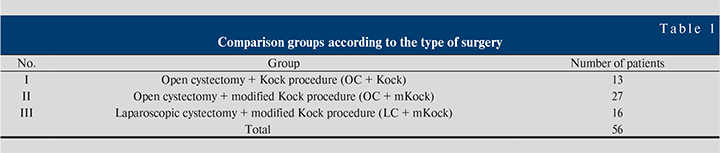
Thus, classical Kock continent cutaneous urinary diversion was performed in 13 patients (23.2%), whereas the modified technique was used in 43 patients (76.8%). Modified Kock urinary diversion was performed in 27 patients (48.2%) undergoing open cystectomy and in 16 patients (28.6%) undergoing laparoscopic cystectomy. Groups I–II and II–III were compared. Assessment of group homogeneity, clinical characteristics, and postoperative follow-up duration is presented in Table 2.
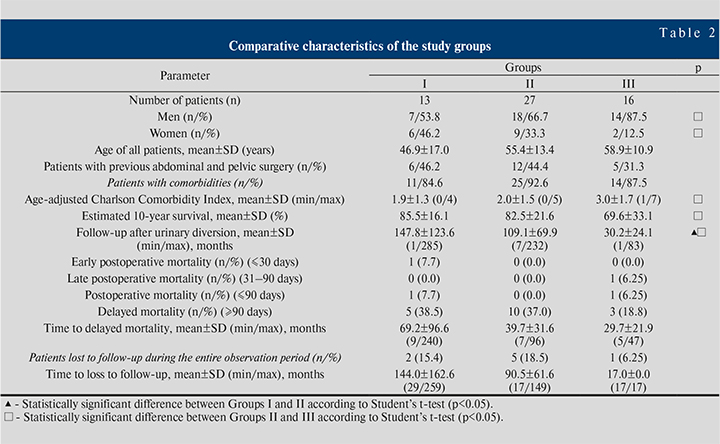
A minor difference in sex distribution was observed between the comparison groups; however, this was not considered to affect the functional outcomes of continent cutaneous urinary diversion. The proportion of patients with comorbidities did not differ significantly among the groups. However, analysis of the age-adjusted Charlson Comorbidity Index showed a greater comorbidity burden in Group III (LC + modified Kock). This group also had a significantly lower estimated 10-year survival.
Differences in mean follow-up duration after urinary diversion were relevant when assessing survival between groups. Nevertheless, follow-up duration in all groups was sufficient for reliable assessment of the functional outcomes of continent cutaneous urinary diversion, which was the primary objective of the study. No significant differences were observed for the remaining variables presented in the table.
It is well established that long-term mortality and loss to follow-up increase with longer observation periods. This was confirmed in our study by multivariable regression and correlation analysis, with correlation coefficients ranging from r=0.17 to r=0.25; however, no significant between-group differences in these parameters were identified (p>0.05, Fisher’s F-test). The conditions constituting indications for cystectomy and the frequency of procedures performed in the study groups are presented in Table 3.
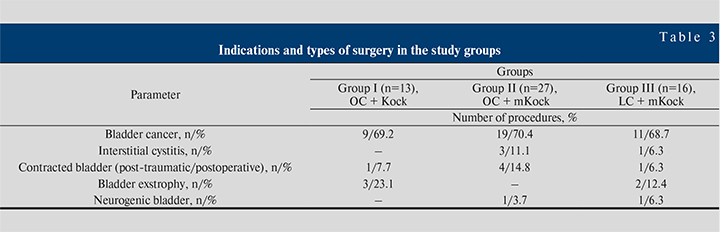
The prevalence of bladder cancer did not differ significantly among the groups: Group I, 69.2%; Group II, 70.4%; and Group III, 68.7% (p >0.05). Patients with non-oncological diseases were also distributed evenly among the groups: Group I, 30.8%; Group II, 29.6%; and Group III, 31.3% (p>0.05). Thus, comprehensive analysis of the selected clinical groups confirmed an adequate number of patients in each group and sufficient comparability of the cohorts according to the principal parameters analyzed.
The study included long-term clinical and functional outcomes of a consecutive series of 56 patients who underwent cystectomy and continent cutaneous urinary diversion between 1995 and 2022. Preoperative and postoperative data, including all subsequent visits and questionnaire assessments at 3, 6, 12, and 24 months and thereafter once every 3 years, were standardized and prospectively entered into a single Microsoft Access 2021 database (Microsoft Corporation, USA).
Statistical analysis was performed using Statistica 10.0 (StatSoft, USA) and BioStat 2009 (AnalystSoft Inc., USA). Quantitative variables were described using the mean and standard deviation or median and interquartile range, whereas categorical variables were expressed as frequencies and percentages.
Continuous variables, including differences between study groups, were compared using Student’s t-test or nonparametric tests. Descriptive statistics were used to calculate arithmetic means (M), standard errors, and standard deviations (m) for the general characterization of patients in the comparison groups when the variables were normally distributed. In the presence of significant deviations from normality, the Mann–Whitney test was used for independent samples and the Wilcoxon test for paired samples. Categorical variables were compared using the chi-square test based on absolute frequencies in the Nonparametric Statistics module of Statistica 10.0. A value of p<0.05 was considered significant.
Results. The mean operative time was 489.4±73.3 min (LQ: 380, UQ: 570) in the open cystectomy + Kock group, 386.2±74.7 min (LQ: 290, UQ: 495) in the open cystectomy + modified Kock group, and 423.4±56.8 min (LQ: 340, UQ: 510) in the laparoscopic cystectomy + modified Kock group. Mean blood loss was 635±228 mL (LQ: 350, UQ: 1050) versus 439±180 mL (LQ: 200, UQ: 700) and 323±81 mL (LQ: 150, UQ: 450), respectively. Mean intraoperative blood loss was significantly lower in the laparoscopic cystectomy + modified Kock group than in the open cystectomy + modified Kock group, 323 and 439 mL, respectively, representing a 1.4-fold reduction (Mann–Whitney test, p=0.034).
The frequency and mean volume of blood transfusion were as follows: open cystectomy + Kock, 7 patients (53.8%), 494.3±209.7 mL (LQ: 260, UQ: 730); open cystectomy + modified Kock, 11 patients (40.7%), 408.4±213.3 mL (LQ: 193, UQ: 765); and laparoscopic cystectomy + modified Kock, 2 patients (12.5%), 365.5±47.4 mL (LQ: 323, UQ: 390). The frequency and volume of blood transfusion were lowest in the laparoscopic cystectomy + modified Kock group, at 12.5% and 365.5 mL, respectively, compared with the other groups (χ²=6.57, p=0.010).
The mean length of hospital stay was 22.9±5.1 days (LQ: 17, UQ: 32) in the open cystectomy + Kock group, 18.8±4.2 days (LQ: 13, UQ: 26) in the open cystectomy + modified Kock group, and 13.5±3.4 days (LQ: 8, UQ: 19) in the laparoscopic cystectomy + modified Kock group.
In the laparoscopic cystectomy + modified Kock group, the mean hospital stay was reduced by 5.3 days compared with the open modified Kock procedure, 13.3 versus 18.8 days (χ²=9.51, df =4, p=0.022).
Repeat surgical procedures performed during postoperative follow-up were analyzed in detail (Table 4). Although there were no statistically significant differences between groups in the frequency of repeat surgery during the early and late postoperative periods or in delayed procedures unrelated to urinary diversion, the number of repeat interventions per patient during these periods was lowest in the laparoscopic cystectomy + modified Kock group (p>0.05).
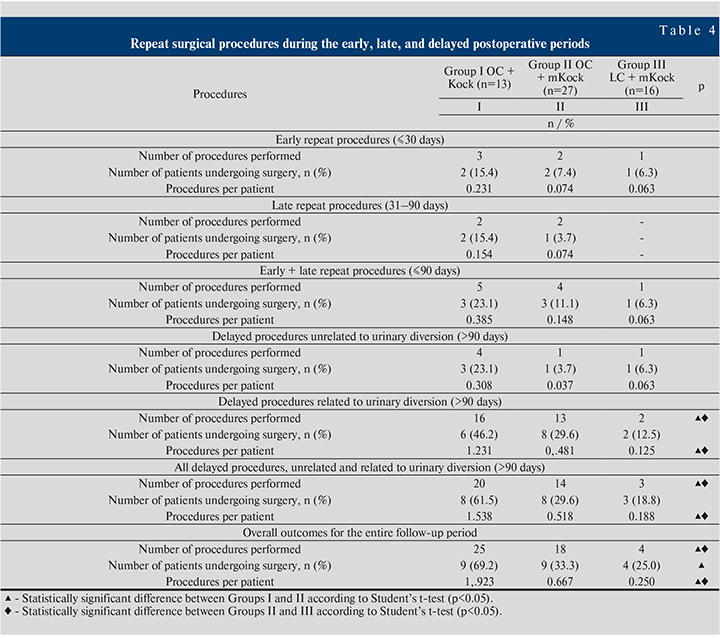
Delayed repeat procedures related to urinary diversion included reservoir lithotripsy, excision of prolapsed valve mesh, extracorporeal shock wave lithotripsy of renal calculi, percutaneous treatment of upper urinary tract stones, and valve revision.
Reservoir lithotripsy was performed more frequently in the open cystectomy + Kock group than in the open cystectomy + modified Kock group, with rates per patient of 0.384 (38.4% of patients) and 0.295 (25.9% of patients), respectively. Excision of prolapsed valve mesh was required in 3 patients in the open cystectomy + Kock group (23.1%; 0.231 procedures per patient) and in 1 patient in the open cystectomy + modified Kock group (3.7%; 0.037 procedures per patient). Thus, the frequency of excision of prolapsed valve mesh decreased 6.2-fold with the modified procedure. The most common delayed repeat procedures related to urinary diversion were percutaneous treatment of upper urinary tract calculi and valve revision. The frequency of these procedures per patient was 0.615 in the open cystectomy + Kock group (3 patients, 23.1%), 0.185 in the open cystectomy + modified Kock group (3 patients, 11.1%), and 0.125 in the laparoscopic cystectomy + modified Kock group (2 patients, 12.5%). A significant difference was observed between the open cystectomy + Kock and open cystectomy + modified Kock groups (p<0.05), with a higher number of procedures per patient in the classical Kock group.
Overall analysis of all delayed repeat procedures related to urinary diversion demonstrated a significant difference in their frequency among the comparison groups (p<0.05) (Table 4). Valve revision was required in 4 patients (30.8%) following the classical open Kock procedure, compared with 3 patients (7.0%) following the modified procedure, combining the open and laparoscopic modified Kock groups. Thus, modification of the Kock valve formation technique reduced the rate of valve revision 4.4-fold. Overall rates of all delayed procedures clearly demonstrated a significant difference in repeat surgery frequency, which was 3.0-fold higher in the open cystectomy + Kock group than in the open cystectomy + modified Kock group (p<0.05) (Table 4). A significant difference was also observed between the open cystectomy + modified Kock and laparoscopic cystectomy + modified Kock groups, with a 2.8-fold lower rate in favor of laparoscopic cystectomy + modified Kock (p<0.05) (Table 4). Analysis of cumulative outcomes over the entire follow-up period demonstrated the same pattern: the number of repeat procedures per patient was 2.9-fold lower in the open cystectomy + modified Kock group than in the open cystectomy + Kock group and 2.7-fold higher than in the laparoscopic cystectomy + modified Kock group (p<0.05) (Table 4). Readmission within 90 days after surgery was required in all groups: 3 patients (23.1%) in the open cystectomy + Kock group, 3 (11.1%) in the open cystectomy + modified Kock group, and 1 (6.3%) in the laparoscopic cystectomy + modified Kock group. During the delayed postoperative period, the corresponding figures were 8 patients (61.5%), 7 (25.9%), and 2 (12.5%), respectively. The number of hospitalizations was significantly higher in the open cystectomy + Kock group than in the other groups (p<0.05), whereas no significant difference was observed between the open cystectomy + modified Kock and laparoscopic cystectomy + modified Kock groups (p>0.05).
According to our data, modification of the Kock procedure reduced the rate of reservoir stone formation by 1.4-fold in the open cystectomy + modified Kock group, with 6 patients (22.2%; 0.222 events per patient), compared with 4 patients (30.8%; 0.308 events per patient) in the open cystectomy + Kock group, although the difference was not significant (p>0.05). Correction of Kock valve insufficiency was required in 1 patient in the open cystectomy + Kock group (7.7%; 0.077 procedures per patient).
The primary objective of the study was to compare the functional outcomes of the classical Kock reservoir (open cystectomy + Kock) and the modified Kock reservoir (open cystectomy + modified Kock and laparoscopic cystectomy+modifiedKock).Usingclinicalinvestigations, including ultrasonography, contrast-enhanced CT, reservoirography, and endoscopic examination, as well as functional testing with comprehensive urodynamic studies and patient questionnaires, we assessed the functional and anatomical reservoir capacity, intraluminal pressure, frequency of daytime and nighttime self-catheterization, ease of catheterization, and continence characteristics.
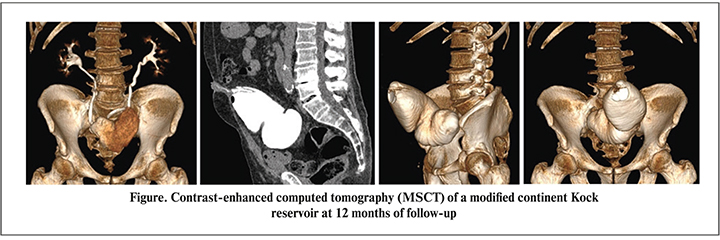
Contrast-enhanced CT performed at scheduled follow-up visits for oncological surveillance also enabled assessment of upper urinary tract urodynamics, as well as the configuration, dimensions, and spatial position of the heterotopic reservoirs and ureteroenteric anastomoses, with evaluation for obstructive changes (Fig.).
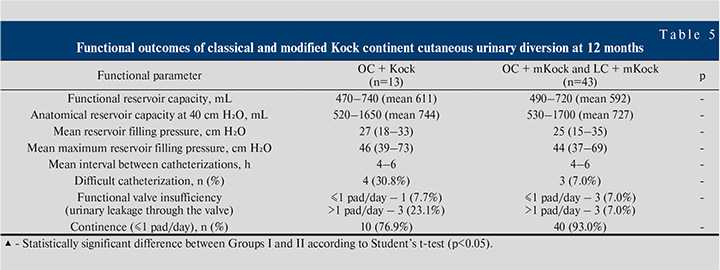
Functional assessments, including patient questionnaires, were performed at 3, 6, and 12 months. Comparative functional outcomes of classical and modified Kock reservoirs at 12 months are presented in Table 5. Immediately after catheter removal, the functional capacity of the classical and modified Kock reservoirs was 80–130 mL (mean 102 mL) and 70–140 mL (mean 96 mL), respectively. At 3 months, the corresponding values were 320–400 mL (mean 356 mL) and 320–390 mL (mean 346 mL); at 6 months, 470–670 mL (mean 550 mL) and 470–640 mL (mean 523 mL); and at 12 months, 470–740 mL (mean 611 mL) and 490–720 mL (mean 592 mL), respectively.
These findings demonstrate a relatively rapid increase in functional reservoir capacity during the first 6 postoperative months, from an initial mean of approximately 100 mL to approximately 550 mL. During the subsequent 6 months, the increase was minor, with reservoir capacity reaching approximately 600 mL and remaining stable thereafter.
Anatomical reservoir capacity was assessed during reservoiroscopy under anesthesia using passive irrigation with fluid warmed to 37.0°C from a height of 40 cm above the reservoir until the flow of irrigation fluid ceased. Mean anatomical reservoir capacity at 12 months did not differ significantly between the comparison groups (p>0.05) (Table 5). Comprehensive urodynamic testing was used to objectively assess reservoir peristaltic activity, changes in intraluminal pressure, reservoir capacity, the volume at which the first sensation of filling occurred, and subsequent definite sensations of fullness. Mean baseline filling pressure did not differ significantly between the classical and modified Kock reservoirs and did not exceed 40 cm H2O in either group at 12 months of follow-up (Table 5).
According to urodynamic findings, peristaltic activity with peak increases in reservoir pressure decreased during the first 6 months and became almost negligible by 12 months after surgery, remaining stable thereafter.
At 12 months, the mean interval between catheterizations was 4–6 hours in both groups. Approximately 10% of patients in each group performed self-catheterization every 3–5 hours, 80% every 4–7 hours, and approximately 10% reported intervals of up to 6–10 hours.
Uncomplicated self-catheterization was reported by 9 patients (69.2%) in the classical Kock group and 40 patients (93.0%) in the modified Kock group. Thus, the rate of difficult catheterization decreased by 23.9%, corresponding to a 4.5-fold reduction, with the modified procedure compared with the classical Kock technique.
Functional valve insufficiency, manifested by urinary leakage through the valve, was reported by 4 patients (30.8%) following the classical procedure and by 6 patients (14.0%) following the modified procedure. The modified technique reduced the rate of incontinence by 16.1%, corresponding to a 3.3-fold reduction.
Accordingly, 9 patients (69.2%) in the classical group and 37 patients (86.0%) in the modified group remained completely dry. Functional success was defined as socially acceptable continence with the use of no more than one pad per day. Based on this definition, continence was achieved in 10 patients (76.9%) and 40 patients (93.1%) in the classical and modified Kock groups, respectively, representing an improvement of 16.2% (1.2-fold) with the modified Kock reservoir.
Discussion. Use of the modified Kock continent cutaneous urinary diversion technique during open cystectomy reduced operative time by 1.3-fold, primarily because only one continence valve was constructed instead of the two valves used in the classical procedure. Performing the cystectomy laparoscopically as part of the modified procedure reduced surgical trauma, blood loss, and the frequency and volume of blood transfusion and significantly shortened the mean postoperative hospital stay.
Comparison of complications and associated repeat procedures during the early and late postoperative periods revealed no significant differences between classical and modified Kock continent cutaneous urinary diversion. However, significant differences emerged only during the delayed postoperative period and primarily involved procedures related to urinary diversion. The advantages of modified continent cutaneous urinary diversion over the classical Kock procedure and of laparoscopic over open surgery in reducing complications and associated repeat procedures became apparent only when delayed postoperative outcomes were considered. Such outcomes are not captured in most standard surgical reports.
Most patients in our study achieved intervals of at least 4 hours between self-catheterizations, facilitating good social adaptation. Although the differences were not statistically significant, better functional outcomes were observed with the modified procedure, including long-term reliability of the modified Kock valve, uncomplicated self-catheterization, and improved continence in the vast majority of patients.
Conclusions. Although traditional heterotopic continent Kock urinary diversion is becoming less commonly used, thereby unquestionably narrowing the armamentarium of modern reconstructive urology, its modified version remains a promising option for contemporary urological practice.
Further studies aimed at detailed evaluation of the efficacy and safety of continent cutaneous urinary diversion and comparison with other modern urinary diversion techniques will help define its role in treatment algorithms, optimize outcomes, and improve quality of life in patients requiring urinary diversion when orthotopic urinary diversion is not feasible.