

CiteScore
0.7
Scopus
Introduction. Robot-assisted radical prostatectomy (RARP) with pelvic lymphadenectomy (PLND) is the «gold standard» for the surgical treatment of prostate cancer with the risk of lymphatic involvement ≥5% according to predictive nomograms. PLND is associated with the development of lymphatic complications (lymphocele, lymphedema) with a frequency up to 51%.Trishkin M.D., Shpot E.V., Chernov Ya.N., Chinenov D.V., Votyakov A.Yu., Hizriev H.A., Astakhova X.A., Kurepta I.N., Smirnova E.A., Smoleevskiy A.G., Glybochko P.V.
Introduction. Prostate cancer (PCa) is one of the most common malignancies in men. According to global statis-tics, PCa ranks second in incidence among oncourological diseases and fifth in cancer-specific mortality [1, 2]. In the Russian Federation, the past decade has been characterized by a heterogeneous pattern in PCa incidence and mortal-ity rates. A marked decline in 2020 during the COVID-19 pandemic was associated with a temporary deterioration in the epidemiological situation and restrictive measures [3]. These measures led to reduced healthcare-seeking behavior and, consequently, to a decrease in PCa detection rates. At present, the indicators show an upward trend, driven by optimization of outpatient services, implementation of screening methods, advances in diagnostic technologies, and wider adoption of preventive measures [4]. Despite advances in early diagnosis, surgery remains the gold standard for the treatment of localized and locally advanced PCa [5].
In contemporary urological practice, preference is given to endoscopic video-assisted surgical techniques, in par-ticular robot-assisted radical prostatectomy (RARP). The advantages of RARP include a lower risk of intraoperative and postoperative complications, high therapeutic efficacy, and improved early functional outcomes [6, 7]. Extended pelvic lymph node dissection (ePLND) is often performed during the procedure. According to the Clinical Guidelines of the Ministry of Health of the Russian Federation, ePLND is indicated in patients with a risk of lymphatic invasion of ≥5% [8]. Despite ongoing debate regarding the oncological significance of ePLND [9, 10], this procedure remains the most reliable method for assessing the status of regional lymph nodes (LNs) and plays a key role in disease staging [11], given the limited sensitivity of currently avail-able imaging modalities, including magnetic resonance imaging (MRI), computed tomography (CT), and positron emission tomography/computed tomography (PET/ CT), for the detection of micrometastases [12].
The increasing incidence of PCa leads to a growing number of patients undergoing radical prostatectomy with pelvic lymph node dissection (PLND). Frequent compli-cations of extended PLND include lymphocele formation and secondary lower limb lymphedema, which develop as a result of impaired regional lymphatic drainage [13]. In view of these possible postoperative consequences, preserva-tion of the lower limb lymphatic collectors is an important issue as a potential strategy for preventing complications of extended PLND. During a search of the PubMed biomedi-cal database, we identified a study aimed at developing a multispectral fluorescence imaging method for differen-tiating LNs draining the prostate from LNs draining the lower limbs [14]. The main limitation of that study was its preclinical nature, which did not allow reliable extrapola-tion of the findings to human anatomy and disease progres-sion. An alternative approach to intraoperative guidance is radioguided surgery, based on the use of radionuclides followed by detection of their accumulation with a gamma probe. The most extensively studied and most commonly used radiopharmaceutical is 99mTc. This technique has high sensitivity for identifying sentinel LNs associated with the primary tumor [15–17]. No studies were found in the literature evaluating the possibility of using radioguided technologies for intraoperative identification of lower limb lymphatic collectors within the PLND field in order to reduce the incidence of postoperative complications.
Aim. To evaluate the efficiency of an intraoperative navi-gation technique using a gamma probe and a lymphotropic tracer (99mTc) during RARP and ePLND for reducing the incidence of postoperative lymphatic complications.
Materials and methods. A single-center prospective study was crried put at the Institute of Urology and Human Reproductive Health, Sechenov University, from July 2024 to May 2025. The study included 50 patients divided into two groups: the study group: RARP and ePLND with preservation of lower limb lymphatic collectors (LLLCs) (n=23), while in the control group RARP and ePLND without preservation of LLLCs was done (n=27). The study was approved by the local ethics committee (No. 30 dated September 29, 2023). Inclusion criterion: patients scheduled for RARP with ePLND with a calculated risk of regional LNs metastases of ≥5% according to the Memorial Sloan Kettering Cancer Center (MSKCC), Briganti, and Russian Society of Oncourology nomograms. Exclusion criterion: developmental abnormalities of the lower limb lymphatic system identified on lymphoscintigraphy.
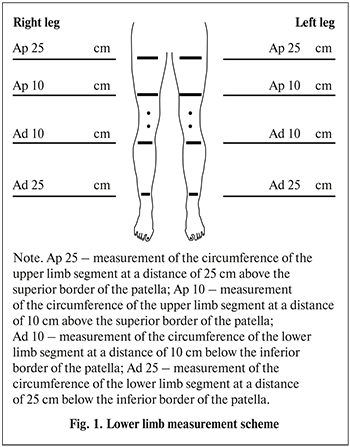
Methods for postoperative monitoring of lymphatic com-plications. To assess lymphocele formation, pelvic ultra-sonography was performed on postoperative days 1, 7, and 90. Lower limb status was assessed by measuring cir-cumferences at four points on each leg (Fig. 1). For these measurements, the patient was placed in a sitting position with the legs flexed at 90 degrees. The patella served as the anatomical landmark. Measurement of the circumference of the upper half of the lower limb was performed 10 cm above the superior border of the patella (first measurement point) and 15 cm distally from that point (second point). An analogous procedure was performed for the lower half of the lower limb, starting 10 cm below the inferior bor-der of the patella. Leg circumference measurements were recorded in centimeters. The truncated cone formula was used to calculate the volume of the proximal and distal parts of the leg (mL). The estimated lower limb volume was calculated as the sum of these two values.
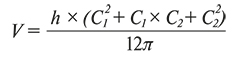
V, lower limb volume, h, cone height (constant of 15 cm), C1, proximal measurement, C2, distal measurement.
Patients underwent lower limb lymphoscintigraphy with single-photon emission computed tomography/computed tomography (SPECT/CT) of the pelvic organs using a radiopharmaceutical labeled with 99mTc at a dose of 50 MBq for each leg, administered intradermally (effec-tive dose 0.2+3.3 mSv), on the day before surgery to assess preservation of lymphatic transport function and to exclude lymphatic block and reflux. The injection site was the first interdigital space of the feet. On the day of surgery, 120 minutes before the procedure, the radiopharmaceutical was administered again.
Patients underwent lower limb lymphoscintigraphy with single-photon emission computed tomography/computed tomography (SPECT/CT) of the pelvic organs using a radiopharmaceutical labeled with 99mTc at a dose of 50 MBq for each leg, administered intradermally (effective dose 0.2+3.3 mSv), on the day before surgery to assess preservation of lymphatic transport function and to exclude lymphatic block and reflux. The injection site was the first interdigital space of the feet. On the day of surgery, 120 minutes before the procedure, the radiopharmaceutical was administered again.
Surgical technique. All procedures were performed through a transperitoneal approach using the Da Vinci Xi robotic surgical system (Intuitive Surgical, United States). Radioguidance was carried out using a rigid laparoscop-ic gamma probe (Amplitude Research and Technology Center LLC, Russia) connected to a portable personal computer with Radikal software (Amplitude Research and Technology Center LLC, Russia). The sterile gamma probe was introduced into the abdominal cavity through a 12-mm port located above the right iliac crest. Real-time feedback on 99mTc activity measurements was provided by the portable personal computer with digital display and acoustic guidance. Background measurements on the transversus abdominis muscle served as the reference. In addition, radioactivity signals from structures located near the lower limb lymphatic collectors, including the ureters and iliac vessels, were measured to assess possible nonspe-cific uptake of the radioactive signal. Imaging results were considered positive if the activity of the radioactive tracer in the examined tissues exceeded the reference background value by 1.5 times. After verification of the lower limb lym-phatic collectors, lymph node dissection was performed with preservation of these structures.
During ePLND, fibrofatty tissue with LNs located between the external and internal iliac vessels was removed from the level of the bifurcation of the common iliac artery to the artery encircling the pubic bone (a branch of the obturator artery). The lateral boundary of the lymph node dissection was the genitofemoral nerve, the medial bound-ary was the obturator nerve, and the posterior boundary was the obturator muscle. After pelvic lymph node remov-al, RARP was performed.
Methods of statistical data analysis. Statistical analysis was performed using Microsoft Excel 2021 and MedCalc v20.104 software. Quantitative data are presented as stan-dard descriptive statistics, including mean and standard deviation (M±SD), standard error of the mean (SE), and the 95% confidence interval for the sample mean. Variables with non-normal distribution are presented as median and interquartile range, Me [Q25; Q75]. Qualitative vari-ables are presented as proportions and frequencies (%). Treatment outcomes were assessed during the first three months after surgery.
Comparison of the two groups for quantitative variables was performed using the nonparametric Mann-Whitney U test. Differences between the study groups for qualitative variables were assessed using Pearson’s chi-square test. The significance level for hypothesis testing was set at p<0.005. Control of the type I error rate in pairwise inter-group comparisons was performed using the Bonferroni correction.
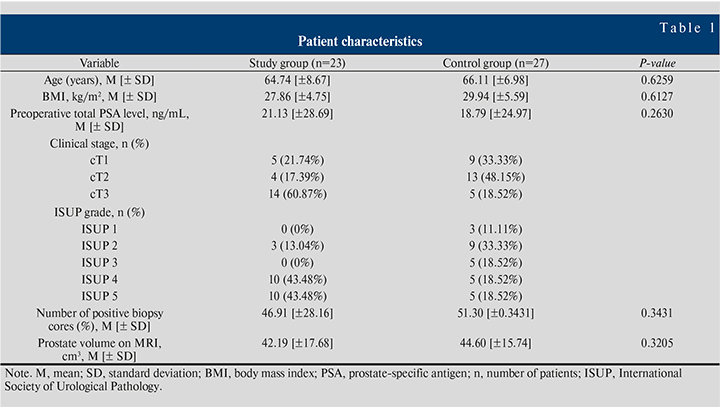
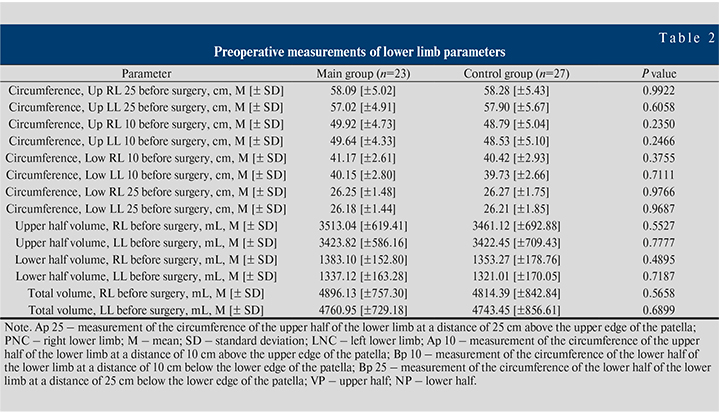
Results. Patient characteristics are presented in Table 1. The participants belonged to the intermediate- and high-risk oncological groups according to the D’Amico classifi-cation. Clinical stages ranged from T1c to T3b. No signifi-cant differences were observed between the study groups. Preoperative measurements of lower limb parameters were statistically comparable between the two groups (Table 2). During surgery, 120 minutes after administration of the radiopharmaceutical, accumulation of the lymphotropic tracer was detected in the fibrofatty tissue located in the region of the external iliac vessels. The median minimum and maximum signals recorded from LNs and lymphatic channels were 240.2 [IQR 45.0; 600.0] and 1135.5 arbitrary gamma probe signal units [IQR 955.75; 1530.25], respec-tively. The main areas of preservation of lymphatic collec-tors within the field of ePLND were as follows: the lateral chain of lymphatic channels and LNs located along the lateral surface of the external iliac artery, the medial chain of lymphatic collectors located along the medial surface of the external iliac artery, and the intermediate chain of lymphatic collectors located between the external iliac vessels (Figs. 2–5).
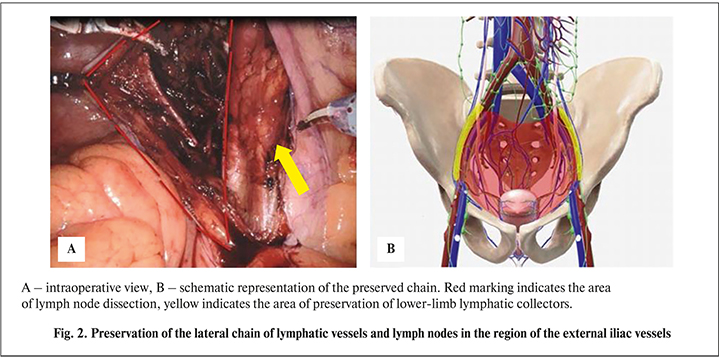
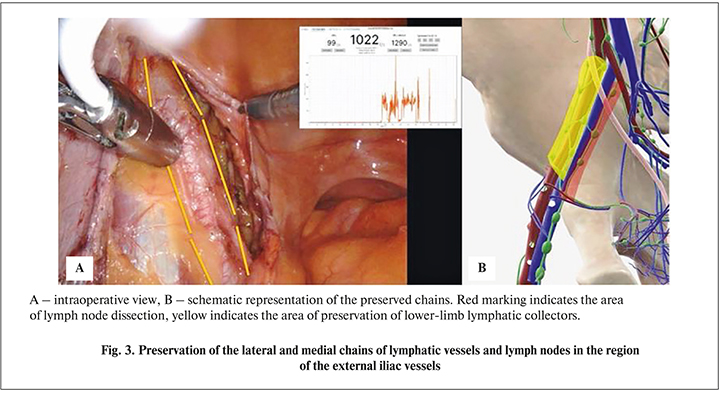
During surgery, 120 minutes after administration of the radiopharmaceutical, accumulation of the lymphotropic tracer was detected in the fibrofatty tissue located in the region of the external iliac vessels. The median minimum and maximum signals recorded from LNs and lymphatic channels were 240.2 [IQR 45.0; 600.0] and 1135.5 arbitrary gamma probe signal units [IQR 955.75; 1530.25], respec-tively. The main areas of preservation of lymphatic collec-tors within the field of ePLND were as follows: the lateral chain of lymphatic channels and LNs located along the lateral surface of the external iliac artery, the medial chain of lymphatic collectors located along the medial surface of the external iliac artery, and the intermediate chain of lymphatic collectors located between the external iliac ves-sels (Figs. 2–5).
The operative time was significantly shorter in the study group than in the control group, averaging 106 minutes ver-sus 115 minutes (p=0.0145). The duration of pelvic lymph-adenectomy was significantly longer in the control group, averaging 27.5 minutes versus 26 minutes in the study group (p=0.038). Mean blood loss was 100 mL [IQR 100; 150] in the study group and 150 mL [IQR 100; 200] in the control group, with no significant difference (p=0.2083). The mean number of removed LNs in the study and con-trol groups was 9.48 [±5.60] and 10.11 [±6.49], respectively (p=0.8990). According to the pathological examination, metastases in removed LNs were detected in 5 (21.74%) patients in the study group and 3 (11.11%) patients in the control group. The time to urethral catheter removal after RARP averaged 6 days in both subgroups and did not dif-fer statistically. In the postoperative period, lymphocele developed in 2 patients in the study group and in 8 patients in the control group (Clavien-Dindo grade I), one of which required repeat laparoscopic surgery followed by drainage (Clavien-Dindo grade IIIb).
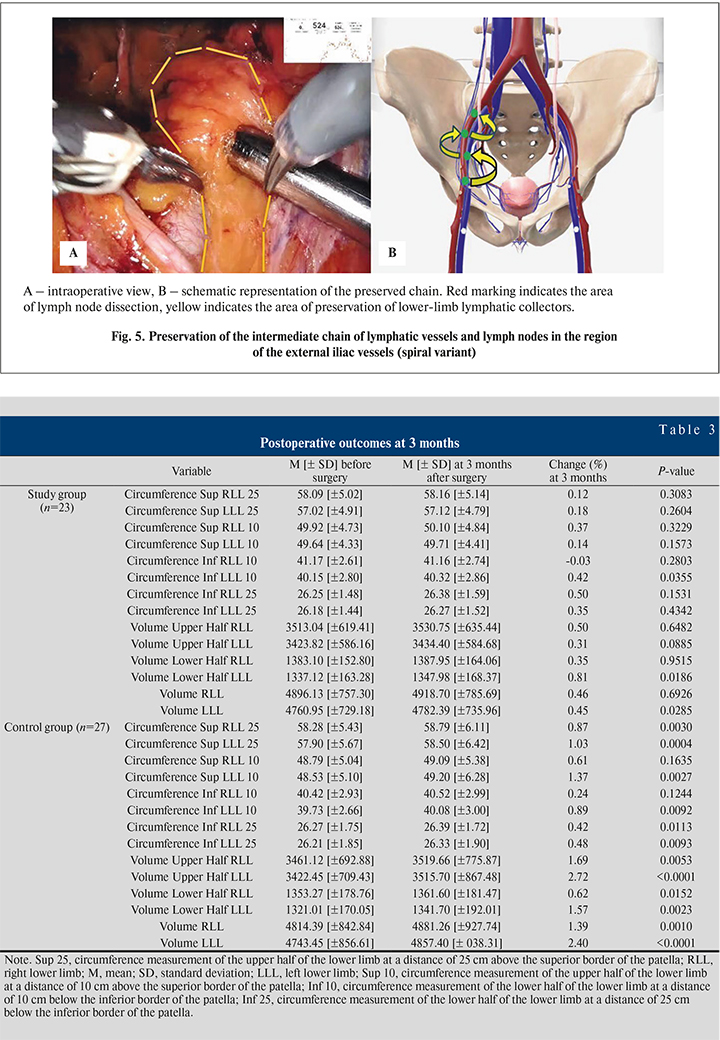
Follow-up was carried out for three months; the median total PSA level in both groups was 0.03 [IQR - 0.01; 0.08]. In addition, secondary lower limb lymphedema devel-oped in 3 (11.1%) patients in the control group, including unilateral lymphedema in 2 patients (7.41%) and bilateral lymphedema in 1 patient (3.7%), compared with 1 patient (4.35%) in the study group. Dynamic assessment of lower limb status at 3 months after surgery demonstrated signifi-cant changes in the absolute majority of parameters in the control group, further indicating the development of post-operative lower limb lymphostasis (Table 3).
Discussion. This is the first reported experience of intraoperative navigation using radioguided surgery and a lymphotropic tracer. According to the preliminary data, the technique may be considered a method for minimizing postoperative lymphatic complications of ePLND.
In intragroup pairwise comparisons, almost all postop-erative parameters obtained from lower limb measurements differed significantly. ePLND with preservation of lower limb lymphatic collectors required less time (26.0 min [IQR 23.0; 27.0]) compared with ePLND without preservation of lower limb lymphatic collectors (27.0 min [IQR 26.0; 29.0]), which may be explained by preservation of part of the fibrofatty tissue during lymph node dissection; as a result, the surgical procedure took less time overall (106.0 min [IQR 99.0; 113.0] versus 115.0 min [IQR 109.5; 118.5]).
When analyzing the extent of PLND in the study cohort, the median number of removed LNs was 9.5 [range: 1–32]. The question of the minimum number of removed LNs required to ensure adequate control of disease progression remains controversial. In the study by Sayedin et al., the correlation between the number of LNs removed during extended PLND and biochemical recurrence-free survival was assessed [18]. According to the results of that analy-sis, with a median number of removed LNs of 5 [range: 1–33], no correlation was established between the extent of lymph node dissection and recurrence-free survival in the intermediate- and high-risk patient cohorts. These conclu-sions are supported by a study that included a large-scale analysis of the CaPSURE database with assessment of 5-year recurrence-free survival [19]. In that cohort of 4693 patients, in which the median number of removed LNs was 5.8 [range: 0–71], no significant differences in survival were found either after stratification by risk groups or after dichotomization of the extent of PLND (<9 versus ≥10 removed LNs). However, it should be taken into account that extending the boundaries of PLND is associated with an increased risk of postoperative complications, particu-larly lymphatic complications [20]. The results obtained in our study are consistent with this position.
For robot-assisted procedures, the main methods of intraoperative navigation are fluorescence guidance and radioguided surgery. Wawroschek et al. were the first to describe the potential use of 99mTc nanocolloid during PLND for the detection of lymphatic metastases. In that study, the authors noted limited sensitivity for detecting involved LNs because of variability in lymphatic drain-age from the prostate [21]. In the study by Malkewicz et al., the possibilities of radioguidance in combination with single-photon emission computed tomography/computed tomography (SPECT/CT) were evaluated in patients with intermediate- and high-risk PCa who underwent radical prostatectomy with PLND. Of 119 LNs identified pre-operatively, 118 were visualized using the gamma probe. Both methods had a sensitivity of 90%, whereas specific-ity was low at 6.06%. Despite these results, the use of the described methods makes it possible to assess individual lymphatic drainage patterns in the operative field [22].
In the article by Gondoputro et al., the efficiency and safety of a 99mTc-based prostate-specific membrane antigen tracer were evaluated for improving intraoperative naviga-tion, with an increase in the number of detected involved LNs in 12 high-risk patients. According to the results of that study, sensitivity, specificity, positive predictive value, and negative predictive value were 76%, 69%, 50%, and 88%, respectively [23]. Combined use of intraoperative navigation methods, including radionuclide and fluores-cence mapping, makes it possible to achieve a synergistic effect, increasing the probability of visualization of LNs and lymphatic channels and improving the precision of surgical technique [24, 25].
The main limitations of our study are the duration of follow-up and the small sample size. It is important to emphasize that our work is the first study to present results on the use of the lymphotropic tracer 99mTc for intraopera-tive preservation of lower limb lymphatic collectors in the field of PLND using a gamma probe. Further continuation of the study is planned with an increased sample size and longer follow-up to assess the dynamics of postoperative lymphatic complications. In addition, evaluation of the efficiency of a combined tracer (99mTc and indocyanine green) is planned, as well as analysis of oncological out-comes between the two study groups.
Conclusion. The use of robot-assisted radical prostatec-tomy and extended PLND with intraoperative navigation using a gamma probe and a lymphotropic tracer may reduce the likelihood of postoperative lymphatic complications. It should be noted that further studies are required to confirm the reliability of the obtained results.