

CiteScore
0.7
Scopus
Introduction. Urinary tract infections (UTIs) are among the most common bacterial infections. At the request “cystitis”, there are 12,067 publications in the RSCI system (e.library) as of 10/08/2023 and 16,332 articles were screened in the Pubmed. This is evidence that the problem of cystitis is far from being resolved.Kulchavenya E.V., Treyvish L.S., Telina E.V., Tsukanov A.Yu., Neimark A.I., Neimark A.B., Kholtobin D.P., Razdorskaya M.V.
Introduction. Urinary tract infections (UTIs) are among the most common bacterial infections. At least 150 million people suffer from UTIs each year [1–2]. Women are most susceptible to cystitis, and approximately 60% of them have experienced at least once episode in their lives [1]. In 1/4 patients the disease recurs several months after antimicrobial treatment [3–4]. It is unclear why recurrent UTIs are so resistant. The reasons for recurrent UTI have been cited as resistance of the uropathogen to antibacterial drugs [5], intracellular persistence of the pathogen [6–7], bacterial filamentation and the formation of L-forms [1]. It is believed that filamentation, at least partially, serves as an innate protective mechanism against the human immune system. As a result of the accumulation of additional mass, the filaments may have an increased ability to adhere to host cells and an improved ability to resist to shear forces of urine in the bladder.
Studies using sterile collection of urine (suprapubic aspiration or transurethral catheterization) have shown that 50% of women have bacteria in the bladder [8], while many authors deny the sterility of urine [9]. It should be noted that in many cases bacteriuria is not accompanied by any symptoms. But even in the presence of dysuria, its cause is not always clear. The development of cystitis may depend not only on the bacteria present, but also on its amount, the expression of virulence factors, and the response of the host immune system [8]. Epidemiological studies show that high level of lactobacilli (with the exception of L. iners) protects women from bacterial vaginosis (BV) and from UTIs [4, 10]. Lactobacilli metabolize vaginal glycogen into lactic acid, which results in a low vaginal pH, which in turn inhibits many other uropathogens [10].
When searching for a term “cystitis” in the RSCI system (elibrary), as of 10/08/2023, a total of 12,067 publications were found and 16,332 articles were present in the Pubmed system. This is evidence that the problem of cystitis is far from being resolved.
Materials and methods. Study design. A two-stage retrospective and prospective, open, multicenter randomized comparative controlled study, involving a total of 425 patients with bacterial vaginosis and 77 women with chronic recurrent cystitis, was carried out. In all patients, the vaginal biocenosis was assessed through molecular genetic analysis of epithelium scrapings from the posterolateral vaginal wall. The material was placed in 1.5 ml plastic Eppendorf tubes containing 300 μg of sterile saline solution. DNA was isolated from the biomaterial using a set of Femoflor Screen reagents (NPO DNA-Technology LLC, Russia). Further, an amplification program was launched with detection of fluorescent signals in real time. After this, the total bacterial mass (TBM) of lactobacilli, as well as the opportunistic and pathogenic microorganisms was automatically calculated and the state of the vaginal biocenosis was determined based on their ratio. Femoflor allows to quantify normal flora (Lactobacillus spp.), facultative anaerobes, which include the Enterobacteriaceae, Streptococcus spp., Staphylococcus spp., Gardnerella vaginalis + Prevotella bivia + Porphyromonas spp., Eubacterium spp., Sneathia spp. + Leptotrichia spp. + Fusobacterium spp., Megasphaera spp. + Veillonella spp. + Dialister spp., Lachnobacterium spp. + Clostridium spp., Mobiluncus spp. + Corynebacterium spp., Peptostreptococcus spp. and Atopobium vaginae. In addition, yeast-like fungi, such as Candida spp., Mycoplasma hominis and Ureaplasma (urealyticum+parvum), as well as pathogenic Mycoplasma genitalium were assessed.
The vaginal biocenosis was defined as a normocenosis with the content of lactobacilli in an amount of at least 80% of TBM. Absolute normocenosis was identified in case of the dominance of lactobacilli (a share of more than 80% of TBM); associates of microbiota (Ureaplasma spp., Mycoplasma hominis, Candida spp.) were absent or determined in quantities less than 104 GE/ ml, and conditional normocenosis is a variant of vaginal microbiota, where the proportion of lactobacilli is less than 80% of the TBM, but Ureaplasma spp. and/or M. hominis are also present in an amount of more than 104 GE/ml. In conditional normocenosis of mixed etiology, along with the predominance of lactobacilli (more than 80% of the TBM), Candida spp. and opportunistic mycoplasmas (Ureaplasma spp., M. hominis) in an amount of more than 104 GE/ml was present.
Anaerobic dysbiosis was defined as a variant of vaginal microbiota, characterized by the predominance of obligate anaerobes with a simultaneous decrease in the proportion of Lactobacillus spp. With moderate anaerobic dysbiosis, the proportion of Lactobacillus spp. and the proportion of anaerobic bacteria ranged from 20 to 80% of TBM. With pronounced anaerobic dysbiosis, the proportion of Lactobacillus spp. was below 20%, and the proportion of anaerobic bacteria exceeded 80% of TBM.
Aerobic dysbiosis was defined as a variant of vaginal microbiocenosis, characterized by a predominance of facultative anaerobic bacteria (aerobes) with a decrease in the proportion of Lactobacillus spp. Depending on the severity, moderate aerobic dysbiosis was diagnosed, when the proportion of Lactobacillus spp. and facultative anaerobic bacteria ranged from 20 to 80% of TBM, while pronounced aerobic dysbiosis was established when the proportion of Lactobacillus spp. was below 20%, and the proportion of facultative aerobic bacteria exceeded 80% of TBM [11].
The examination of patients with cystitis included self-completion of the Russian version of the Acute Cystitis Symptom Score (ACSS), urinalysis, and urine culture. For microbiological studies, time-of-flight mass spectrometry was used on a Microflex mass spectrometer (Bruker, Germany). For some cultures, species identification and determination of antibiotic resistance were carried out on BD PhoenixTM combined panels for gram-negative, gram-positive microorganisms and streptococci using an automatic system for identifying microorganisms and determining sensitivity to antibacterial drugs Phoenix 100, USA; Becton Dickinson. For the standardized disc diffusion method, antibiotic-impregnated discs, Mueller–Hinton agar, and Bio-Rad disc dispensers, USA, were used.
In patients with cystitis, local microcirculation was measured using laser Doppler flowmetry (LDF) in the area of the external urethral meatus and at the level of the middle of the urethra from the vagina using the LAKK-02 device (NPP "Lazma", Russia). We determined the dynamics of the microcirculation index (MI) and the change in the coefficient of variation (CV) during treatment.
After this, patients received basic therapy and were randomly assigned to one of the groups:
Superlymph® is a natural complex of antimicrobial peptides and cytokines, which act as universal stimulants of the immune system, secreted by leukocytes in the peripheral blood of pigs. Superlymph® has antiviral, antimicrobial and fungicidal effects, and is also an immunomodulator [12–14]. Acylact Duo is a combination product containing, along with cytokines, acidophilus bacteria (Lactobacillus acidophilus 107).
A follow-up examination was carried out upon completion of the course of treatment.
Statistical analysis. The results were processed using Microsoft Excel spreadsheets from the Microsoft Office software package, 2007. All quantitative data were described as mean (M)±standard deviation (SD). When describing qualitative data, absolute values (n) and percentages (%) were used. The hypothesis about the absence of a statistically significant influence of the factor was rejected at p>0.05.
Results. Among 425 patients with bacterial vaginosis (BV), 78 (18.3%) complained of various urinary disorders, but only 21 patients (4.9% of those with BV and 26.9% of women with dysuria) were diagnosed with cystitis. In all cases it was an exacerbation of a chronic disease. The age of patients with BV ranged from 21 to 48 years, with an average of 36.4±5.9 years. The average age of patients with BV, who also had chronic cystitis, was 48.5±6.4 years (significant difference). Among patients with two disorders, moderate anaerobic dysbiosis was established in 8 (38.1%), pronounced anaerobic dysbiosis in 9 (42.9%), and moderate aerobic dysbiosis in 4 (19.0%) cases.
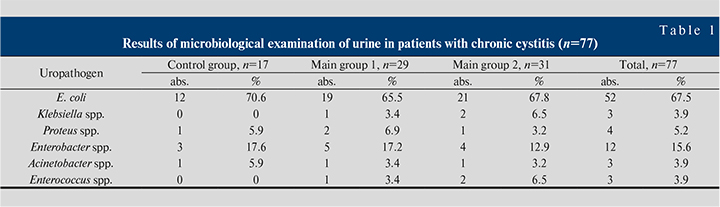
In all 77 patients with chronic cystitis, there was microbiological verification. The spectrum of uropathogens is presented in Table 1. As we can see, the leading uropathogen was E. coli, the frequency of which ranged from 65.5 to 70.6%. In the second place was Enterobacter spp. Not a single isolate had sensitivity to all antibacterial drugs; resistance to fluoroquinolones (46.7%) and amoxiclav (44.1%) predominated. The sensitivity of the microflora to basic therapy was preserved.
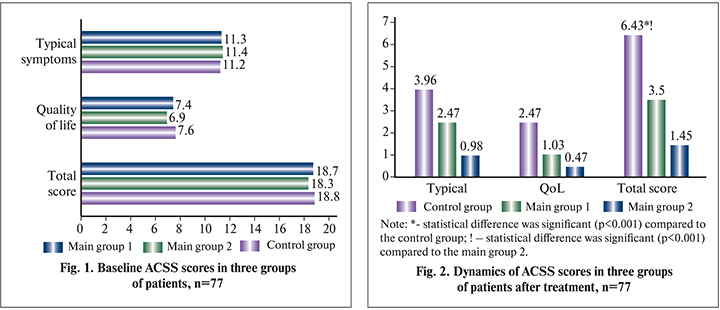
According to the ACSS scale, all patients had a total score exceeding the threshold level. There were no significantdifferencesbetweenthegroups, asdemonstrated by Fig. 1.
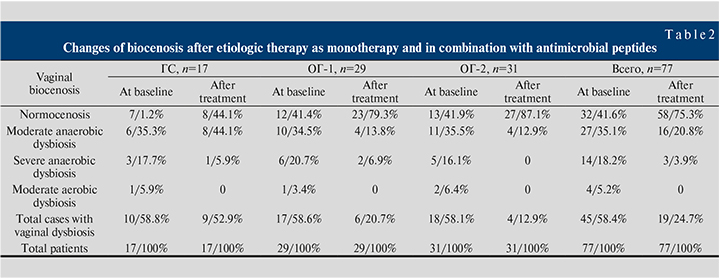
When studying the vaginal biocenosis, it was found that among 77 patients with chronic cystitis, normocenosis was initially present in 32 (41.6%), moderate anaerobic dysbiosis in 27 (35.1%), severe anaerobic dysbiosis in 14 (18.1%) cases and 4 (5.2%) women had moderate aerobic dysbiosis. Thus, 45 (58.4%) patients with chronic cystitis had impaired vaginal microbiocenosis.
Upon completion of therapy, positive results were noted in all groups of patients. Complete eradication of the pathogen was seen in 15 (88.2%) women who received only basic therapy; the remaining two still had Enterobacter spp., but in an extremely low concentration (102 CFU/ml). In main groups 1 and 2, no growth of microflora was detected in 27 (93.1%) and 28 (90.3%) patients, respectively; in the remaining five cases, clinically insignificant (102 CFU/ml) growth of uropathogens was detected (Klebsiella spp., Proteus spp., Enterococcus spp., Enterobacter spp. and E. coli).
Thus, combined etiologic therapy had excellent immediate efficiency. However, when analyzing the dynamics of symptoms on the ACSS scale, statistically significant differences between the groups were found (Fig. 2).
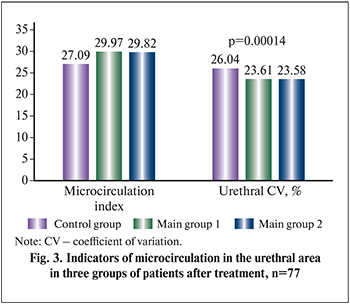
A comparison of microcirculation in the urethral area after therapy also showed the advantage of main groups compared to the control group, although there was a statistically significant difference between the main groups receiving rectal and vaginal suppositories Superlymph®. The results are shown in Fig. 3.
The dynamics of the vaginal biocenosis are shown in Table. 2. The best results (normocenosis in 87.1% of cases) were demonstrated in main group 2, in which patients, along with Superlymph® rectal suppositories, received Acylact Duo vaginally. In the control group, the proportion of patients with normocenosis remained unchanged (7/41.2% vs. 8/47.1% after treatment). In main group 1, receiving only Superlymph® vaginally, the proportion of patients with normocenosis almost doubled, from 41.4% (n=12) to 79.3% (n=23).
Discussion. The increase in resistance of uropathogens, the evolution of E. coli, which has led to a radical change in its properties (high ability to adhere to the urothelium, intracellular persistence, formation of dormant forms), makes it increasingly difficult to select antibacterial therapy in patients with UTIs. In order to solve this problem, it is suggested to prescribe combination of antibiotics [15, 16]. Previously, the combined drug biseptol was popular; now pharmaceutical companies are increasingly bringing to market not a single drug, but a combination of modern antibacterial agents, for example, cefoperazone and sulbactam.
Traditionally, the association between BV and chronic cystitis is considered undisputable. O.H. Harmanli et al. [17] examined 129 gynecological patients, and in 67 (51.9%) BV was diagnosed. Among them, 15 (22.4%) had recurrent cystitis, and among gynecological patients without BV, cystitis was detected in only 6 (9.7%). According to I.V. Kosova et al. [18], among 75 women with chronic cystitis aged 19 to 76 years, BV was detected in 47 (62.7%), with moderate BV in 25 (33.3%), and severe BV in 22 (29.3%) patients. The authors found a correlation between the presence of BV and the number of relapses of cystitis (r=0.310; p=0.007). It was also found that BV is significantly more common in older patients with chronic cystitis who are in menopause. The authors conclude that disruption of the vaginal microflora increases the risk of developing of cystitis and contributes to more severe manifestations. Yu.S. Kovaleva et al. [19] found that 79.5% of patients with chronic cystitis had a complicated gynecological history, including BV.
A.H. Sumati et al. [20] diagnosed BV in 119 (68.39%) of 174 women; 58 (48.7%) of them were also had chronic cystitis. The authors suggest that the association of BV with UTI, and vice versa, is likely due to an increase in vaginal pH and a decrease in the number of vaginal lactobacilli that produce lactate and hydrogen peroxide. Frequent sexual intercourse also increases the risk of developing both BV and cystitis. Taking into account the relationship of these diseases, it is recommended that all patients with BV be examined for UTI, and in those with UTIs, BV should be excluded.
V.L. Handaetal.[21] recentlypublishedacomprehensive chapter “Does Bacterial Vaginosis Contribute to Urinary Tract Infection?” in a thematic collection on female genital tract infections. The authors emphasize that the available data are not enough to draw any definitive conclusions. Limited evidence suggests that BV may increase susceptibility to UTIs and, conversely, that a lactobacilli-dominated vaginal microbiota may protect against these infections. However, there is currently a paucity measures that clinicians can use to alter the relationship between BV, the vaginal microbiome, and UTIs. There is no evidence to support treating BV with antibiotics to reduce the incidence of UTIs. Additional research into the role of BV and vaginal microbiota in the pathogenesis of UTIs is warranted and in future may lead to the development of new treatments for UTIs and improved genitourinary health in women.
Our findings are also contradictory. On the one hand, UTIs in patients with BV were detected in only 4.9% of cases; on the other hand, BV was diagnosed in 58.4% of patients with chronic cystitis. The main question is what comes first? Possibly, multiple repeated courses of antibiotic therapy for cystitis led to the development of BV, and it was not the disruption of the vaginal microbiota that contributed to the development of cystitis? This disproportion can also be explained by the fact that cystitis has more apparent manifestations than BV, which may have more obscure course, and a patient attends a doctor with cystitis, while BV is identified as a secondary disease or is not diagnosed at all.
N.M. Gilbert et al. [22] proposed the activation of latent intracellular reservoirs of E. coli in the bladder mucosa as one of the mechanisms of UTI. Exposure of the urinary tract to G. vaginalis during sexual activity leads to detachment of the bladder epithelium. After exfoliation, E. coli leaves the intracellular reservoirs into bladder lumen and causes inflammation. Thus, UTI may be caused by short-term but severe exposure of the urinary tract to vaginal bacteria that are not “pathogenic” in the classical sense.
This “latent pathogenesis” paradigm may apply to other latent infections (e.g., tuberculosis) or to diseases that are currently defined as noninfectious since routine cultural study fails to detect relevant pathogens [23].
In an open-label phase II clinical trial, 28 participants used vaginal suppositories containing Lactobacillus Crispatus for 1 year or every 2 days, or 3 times a week. The primary endpoint was response rate, assessed by the number of episodes of recurrent cystitis during a year. Secondary endpoints were response rate assessed by episodes of recurrent cystitis within 1 year after completion of therapy; total number of episodes of recurrent cystitis before, during and after therapy; adverse events; changes in the spectrum and severity of bacteriuria and the dynamics of the vaginal microbiome. A total of 18 (86%) patients achieved an effective clinical response. The suppressive effect of vaginal Lactobacillus suppositories on episodes of cystitis lasted up to 1 year after the last suppository was administered. Authors concluded that vaginal suppositories containing the Lactobacillus crispatus strain were effective in preventing episodes of recurrent cystitis both during treatment and for at least 1 year [24–25].
Another study also showed that eliminating risk factors, which include BV, significantly reduces the number of relapses and lengthens the relapse-free period in women with recurrent UTI [3].
I.A. Apolikhina and D.A. Malyshkina [26] published the results of an anonymous survey of 102 obstetricians and gynecologists regarding the treatment of women with cystitis. Interestingly, only in 42% of cases gynecologists send a patient with dysuria to a urologist, and in 51% they administer therapy on their own, which, of course, requires them to know the relevant guidelines. Gynecologists noted that in 31% of patients receiving monotherapy with antibiotics, the effect was short-term and the disease recurred. The authors also emphasize that antibacterial therapy leads to intestinal dysbiosis and BV, which is a risk factor for the development of relapse of chronic cystitis.
We believe that the difference in results in our study is due to the multicomponent pathogenesis of cystitis, the influence on the clinical manifestations of not only the pathogen, but also the degree of disruption of microcirculation and vaginal biocenosis. This hypothesis is confirmed by the significant differences between groups. Conclusion. There are ontological and phylogenetic prerequisites for the chronic course of the inflammatory process in the bladder wall in women. The bladder trigone has a common origin with the vagina [4], which explains the mutual influence of BV and cystitis. According to our data, 4.9% of patients with BV were diagnosed with chronic cystitis, but 58.4% of patients with chronic cystitis had vaginal dysbiosis. Perhaps this discrepancy is explained by incomplete diagnosis and insufficient attention of doctors to concomitant pathology; carrying out an examination of all patients with cystitis for BV, and all patients with BV for cystitis, would allow us to obtain a true situation.
The use of a complex of antimicrobial peptides and cytokines allows to significantly increase the bidirectional effect of therapy, with the best results obtained with rectal use of Superlymph suppositories and vaginal use of Acylact Duo.