

CiteScore
0.7
Scopus
Introduction. Chronic recurrent cystitis (CRC) is a complex multifaceted problem of modern uroinfectology.Ibishev Kh.S., Mamedov V.K., Migacheva N.B., Kogan M.I.
Introduction. Chronic recurrent cystitis is a complex multifactorial problem of modern urologic infectiology [1–3]. Owing to the development of new diagnostic methods and recent advancements in the studying of pathogenetic basis of infectious and inflammatory lower urinary tract diseases, associated with the new paradigm that urine is not sterile, as well as the whole urinary tract, the traditional opinion about the etiological structure, pathogenesis, and diagnostic methods and treatment has been changing [4–7]. It is known that under certain predisposing factors, cystitis can be caused not only by aerobic pathogens, but also by anaerobic bacteria, viruses, and fungi [8–10]. In this regard, diagnostic methods also change, and is not always consistent with clinical guidelines [11–13]. In addition, given that treatment of chronic recurrent cystitis, in accordance with generally accepted recommendations, is accompanied by a high rate of relapse, the feasibility of a differential approach to the diagnosis and treatment is emphasized [14, 15].
In this regard, with current knowledge of the etiology, pathogenesis and diagnosis of chronic recurrent cystitis of any origin, the pathophysiology is recognized as multifactorial, despite the fact that some dominant mechanisms are postulated, such as infectious, autoimmune, neurological, endocrine and psychological [16, 17].
It has also been proven that chronic nature of the infectious and inflammatory process in the bladder is associated with dysfunction of local immunity. It is known that the mucosa-associated lymphoid tissue of the urinary tract includes various cells of innate and adaptive immunity: epithelial cells, lymphocytes, macrophages, dendritic and mast cells, natural killer cells. Their dysfunction is one of the leading pathogenetic mechanisms for the development of cystitis [18].
Moreover, the bladder has passive protection, such as mucus, antimicrobial peptides, secretory immunoglobulins, etc., which protect it from microbial colonization. Undercertainpredisposingfactors, including dysfunction of local immunity, these mechanisms may be impaired. In this case, the urothelium and resident immune cells produce additional protective molecules, cytokines and chemokines, which attract inflammatory cells to the infected tissue.
Resident and recruited immune cells act together to eliminate bacteria in the bladder and to develop robust immunological memory against infection [19, 20]. Some active peptides and cytokines can be used in screening and differential diagnosis of chronic recurrent cystitis.
Aim. To study the immunological parameters of urine in patients with chronic recurrent cystitis depending on the etiological factor.
Materials and methods. Ethical statement. The study was planned, carried out in accordance with the provisions of the Declaration of Helsinki (revised in Fortaleza, Brazil, in October 2013) and approved by the Local Independent Ethical Committee of the FGBU VO Rostov State Medical University of the Ministry of Health of the Russian Federation based on review of the design and work implementation plan (protocol No. 16/17 from 05.10.2017).
The study was carried out as part of the scientific work “Optimization of differential diagnosis and selection of first-line therapy for chronic recurrent cystitis in women” and had no sponsorship.
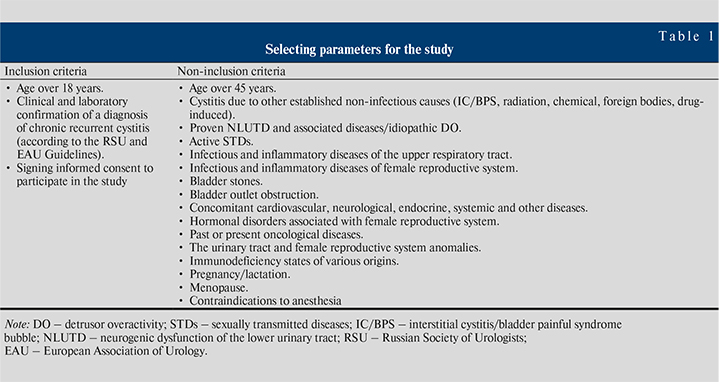
Patients. The prospective study included 71 patients aged 20–45 years who had a diagnosis of chronic recurrent cystitis in acute phase. The inclusion and non-inclusion criteria to participate in the study are shown in Table 1.
The initial examination included assessment of complaints, taking medical history, culturological and polymerase chain reaction (PCR) analysis of the morning midstream specimen of urine, urethral and vaginal swab test, and cytological examination of urine. The survey methodology was described in detail in previous works [14, 17]. Based on the results of bacteriological and PCR studies of urine, urethral and vaginal swab test, patients were divided into three groups, depending on the dominant etiological factor: group 1 (n=30) with papillomavirus etiology, group 2 (n=30) with bacterial causative factor (B-CRC), group 3 (n=11) with candida cystitis.
Analysis of immunological parameters of urine was carried out using an enzyme-linked immunosorbent assay (ELISA-BEST). The following pro-inflammatory cytokines were determined: interleukin 1-beta (IL-1 beta) (normal range: 0–11 pg/ml), interleukin-8 (IL-8) (0–12.0 pg/ml), interleukin-6 (IL-6) (0.0–7.0 pg/ml). In addition, anti-inflammatory cytokines were also studied: interleukin-4 (IL-4) (0–4 pg/ml), as well as tumor necrosis factor (TNF) (<6 pg/ml), interferon-alpha 2b (IFNα-2b) (0–20 pg/ml), and interferon-gamma (IFNγ) (0–20 pg/ml).
The determination method was based on a three-stage “sandwich” version of solid-phase ELISA using mono-and polyclonal antibodies to IL-1 beta and antibodies to IL-6, monoclonal antibodies to IL-8 and IL-4, TNF, IFNα -2b and IFNγ. An important stage was to study the levels of IFNα-2b and IFNγ in urine, since it can serve as a guide not only for diagnosis, but also for treatment of patients with chronic recurrent cystitis of various origins. In addition, calibration samples were used containing a known amount of IL-1 beta, IL-6, IL-4, IL-8, TNF streptavidin-horseradish peroxidase conjugate, which is ready-to-use solution for the recovery of calibration and control samples of IL (RBO), solution for sample dilution, phosphate-buffered saline solution with Tween (PBS-T×25) and tetramethylbenzidine solution (TMB plus). After measuring the optical density of the solution in the wells, the concentration in the analyzed samples was calculated based on the calibration graph.
Methodology for studying immunity indicators. An enzyme immunoassay using antibodies to IFNα-2b and IFNγ in the wells, when a test sample of serum was added during the first incubation, IFNα-2b or IFNγ binds to monoclonal antibodies immobilized on the inner surface of the wells of the plate. During the second incubation, the peroxidase conjugate of polyclonal antibodies to IFNα-2b or IFNγ binded to interferon alpha immobilized during the first incubation. During incubation with a tetramethylbenzidine solution, the solution in the wells became colored. The degree of coloring was directly proportional to the levels of IFNα-2b or IFNγ in the analyzed samples.
Statistical analysis was performed using Excel spreadsheets (Office, 2019) and Statistica 10.0 software (StatSoft Inc., USA). Numerical data are presented as a median value (Me) and quartiles (Q1; Q3). The statistical significance of intergroup differences was assessed using nonparametric tests: the Mann–Whitney test when comparing two groups and the Kruskal–Wallis test if three or more independent groups were compared. A Chi-square test (with Yates correction) and Fisher's exact test were used for comparison of the proportions of qualitative data. The generally accepted criterion for significance was used (p≤0.05). The Bonferroni test for multiple comparisons was taken into account. Conventional significance levels were used (p<0.05).
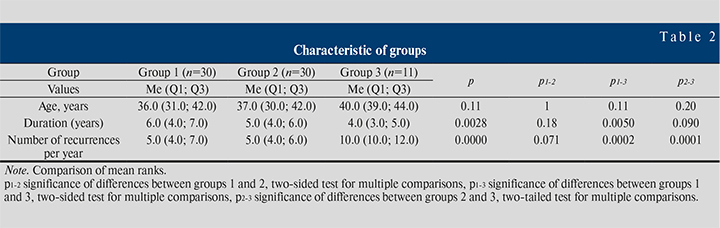
Results. All groups were comparable in age of patients. In terms of the duration of the disease, significant differences were found between groups I and III. Moreover, there were significant differences in the number of recurrences during the year between groups I and II, on the one hand, and group III, on the other (p<0.05) (Table 2).
When assessing TNF levels, significant differences were found between the study groups. Me (Q1; Q3), and the maximum and minimum values corresponded to the normative values only in patients of group I. Me, Q3 and minimum values in groups II and III were significantly different, while maximum values were almost equivalent (Fig. 1).
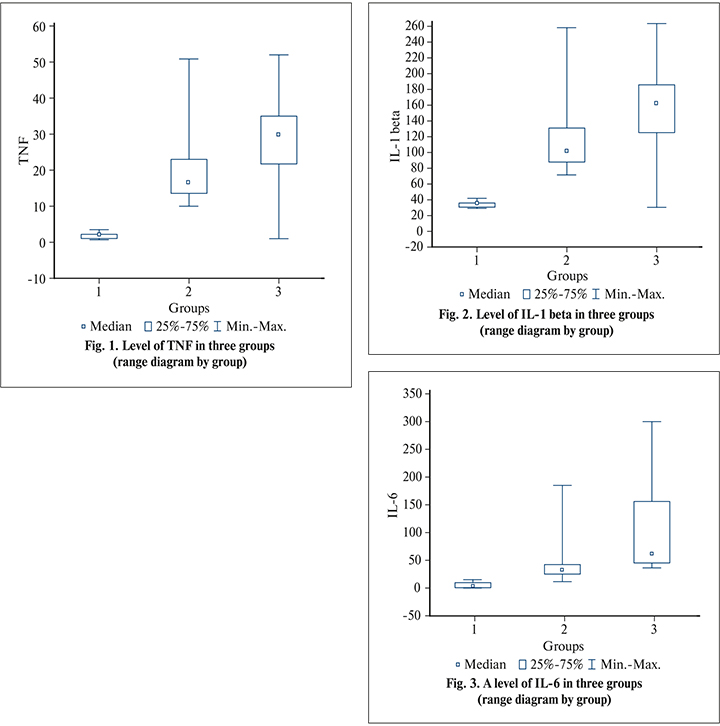
Me of IL-1 beta and IL-6 corresponded with TNF levels, and were significantly higher in patients of group III; in group I, Me and (Q1; Q3) remained within the reference values (Fig. 2, 3).
Regarding the IL-8 levels, it was almost identical in groups II and III, with equivalent Me, although there were differences in (Q1; Q3), maximum and minimum values.
In addition, values in groups II and III were significantly different compared with group I. Despite some differences in IL-8 levels, in all groups it corresponded to an infectious and inflammatory process, which was more severe in groups II and III (Fig. 4).
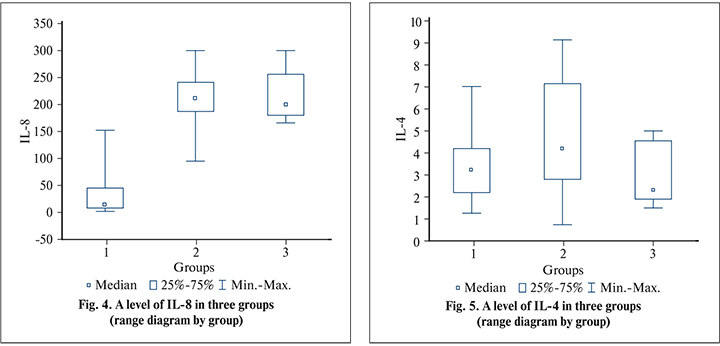
The level of IL-4 in all groups was within normative values, which indicates the absence of an allergic component in the pathogenesis (Fig. 5).
Meanwhile, IFNα-2b level was identical in patients of groups I and III, both in terms of Me and (Q1; Q3) and maximum and minimum values. However, in group II, Me, Q3 and the minimum value corresponded to the reference levels, while Q1 and the maximum value were above the norm (Fig. 6).
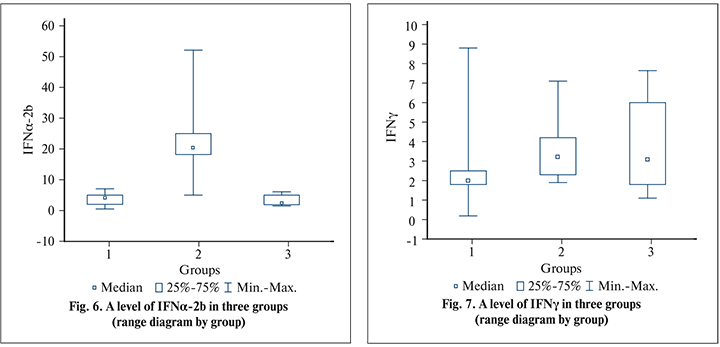
The level of IFNγ in all groups was within the acceptable values (Fig. 7). Thus, the studied groups were virtually comparable in terms of the level of TNF, IFNα-2b and IFNγ (Table 3).
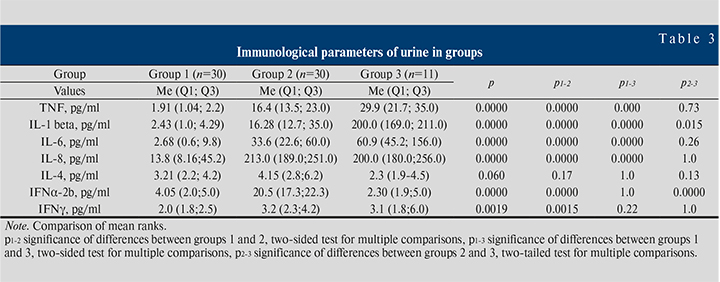
Discussion. In our study the immunological parameters of urine of patients with chronic recurrent cystitis of various origins were analyzed. At the same time, significant differences were found between patients in the levels of TNF and IL-1 beta, IL-6, and IL-8. In those with bacterial and fungal cystitis, there was a significant and significant increase in the levels of IL-1 beta and IL-8, which indicates the active participation of the macrophage component. It is known that an increase in the level of macrophages indicates an active bacterial inflammatory process, in which degranulation of macrophages and neutrophils leads to an increase in the level of interleukins [19]. Definitely, the analysis of interferon levels must be considered align with other laboratory and clinical data. However, a decrease in the production of alpha and gamma interferon during an acute inflammatory process may be a consequence of a chronic viral infection (group I) or the result of a long-term persistent inflammatory process (groups II and III), but in both cases congenital deficiency or acquired depletion of the interferon system is evident, which can be considered an indication for interferon-stimulating therapy.
According to the literature, the stable expression of cytokines and the active and pronounced inflammatory infiltration of various cells in the bladder during the activation of a urinary infection depends on the type of bacteria and gender [20]; women are more likely to develop chronic recurrent cystitis. Moreover, there are some species differences in causative microorganisms [4].
In addition, recent studies have shown differences in immune status by gender, which affect the outcome of inflammatory processes in the urinary tract [21]. Multicenter randomized trials are required.
Our results indicate that the levels of TNF and IL-1 beta, IL-6, and IL-8 can be used as screening criteria in the differential diagnosis of chronic recurrent cystitis of various origins, in order to start correct etiologic therapy, which can be adjusted after obtaining urine culture. Taking into account the levels of IFNα-2b and IFNγ, it is possible to determine the degree of impairment of the immune response and the need for immunostimulating therapy.
Conclusions. Chronic recurrent cystitis is a polyetiological disease, and identification of the etiological factor is a complex task that determines the successful treatment. Our study showed the feasibility of analyzing interleukins in urine (IL-1 beta, -6, -8), since they can serve as a criterion in the differential diagnosis of chronic recurrent cystitis of various origins. In addition, it is reasonable to study the level of IFNα-2b and IFNγ, since when identifying the functional impairment of the IFN system in women with chronic recurrent cystitis, its correction is necessary.