Background. Oxidative stress could cause excessive generation of highly reactive oxygen (ROS) and nitrogen (RNS) species. In addition, it has been reported in disease of kidney as the highly metabolic organ within human body [1]. It is well known that the level of markers associated with oxidative stress increases in progression of chronic kidney disease and that correlated significantly with the level of renal function [2]. Hypoxia and ischemia inside the renal could cause creation of ROS such as peroxides, hydroxyl radicals and superoxide radical anions, that damage biomolecules and membranes and disturb organelle task and persuade renal tubule cell impairment, swelling and vascular dysfunction [3]. Therefore, a well-recognized activators of tissue injury via ROS are ischemia and reperfusion. In fact, ischemia strictly confines cellular oxygen and nutrient uptake, causing in severe tubular necrosis and inflammation that can worsen renal damage and cause functional fluctuations in the kidney [4].
Concerning reperfusion process oxidative stress could cause ischemia that subsequently increase graft dysfunction. In addition, anemia mentioned as an independent risk factor for an increase of oxidative stress after organ transplantation. Associated with graft function (delayed and one year), increased level of malondialdehyde on day 1 and day 7 after transplant considered as prognostic indicator respectively [5]. Inflammation due to oxidative stress could consequently cause cardiovascular disease, cancer, metabolic syndrome and other disorders in transplant recipients. As a result, inflammation markers are indirect signs of oxidative stress [6]. Immunosuppressive therapy could be associated with higher total antioxidant capacity (TAOC) [7]. Evaluation of presence or severity regarding oxidative stress can be assessed by various biomarkers produced from interaction of reactive oxygen species with lipids, proteins, nucleic acids, nitric oxide, glutathione and etc. Expression and activities of antioxidant enzymes as redox-sensitive molecules could be evaluated as biomarkers of oxidative stress [8-11]. In this study, we aimed to describe total anti-oxidant capacity (TAOC) and its’ correlation with immunosuppressive drug blood level in kidney transplant recipients.
Materials and Methods. This cross sectional study was approved by the Institute Ethics Committee (IEC) at our center by Code No; 296116. According to the previous published works the cases size was considered based on this formulation [9, 12–14];
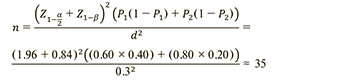
n =Sample size, Zα =Level of confidence according to the standard normal distribution (for a level of confidence of 95%, z = 1.96, for a level of confidence of 99%, z = 2.575), p =Estimated proportion of the population that presents the characteristic, d =Tolerated margin of error,
The study included 35 patients after kidney transplantation and 35 healthy age-matched controls. Patients were monitored by senior clinical pharmacist associated with tacrolimus trough levels. Recipients suspected for rejections episodes excluded from the study. A detailed medical history was obtained from all study participants before their inclusion in the study. Informed written consent was obtained from all study participants and the study protocol was described in detail. Five ml blood samples were taken from both cases and controls. Plasma (n=70) labelled, concealed with foil and kept in -20°C until the day of analysis. Quantitative colorimetric assay, using Human T-AOC Elisa Kit, for measurement of samples were used [9]. Baseline patient characteristics were compared using Pearson’s χ2 test for categorical variables and the Wilcoxon rank sum test for ordinal or continuous variables. Chi-square and student T test were used to compare two groups related to dissimilarity of redox state in kidney transplanted recipients and healthy controls. Correlation analysis was performed in order to find r for tacrolimus trough levels and TAOC. All statistical testing was two-sided with significance set at p≤0.05.
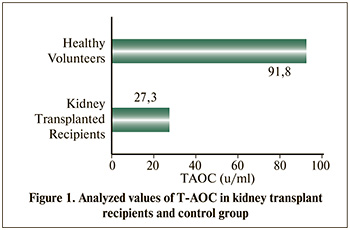
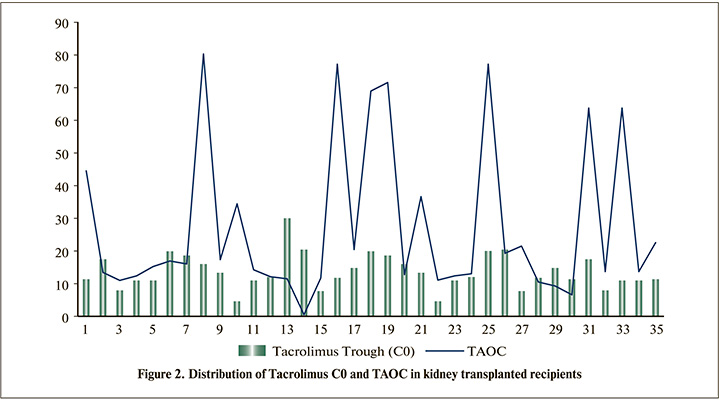
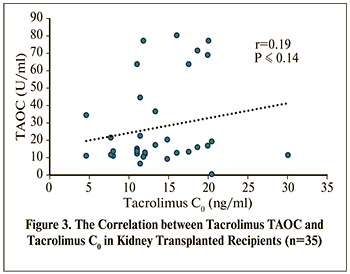
Results. The mean±SD age in the control group versus kidney transplanted recipients was 59.5±13.4 versus 55.8±13.0 (P≤0.42). With a minimum of 0.5 and a maximum of 80.2, the mean TAOC in kidney recipients was 27.3±24.1 U/ml. As Shown in Figure 1, in healthy volunteers the mean TAOC with a value of 91.8±24.1 U/ml (minimum 56, maximum 125 U/ml) was significantly higher than kidney transplanted recipients (P≤0.01). With a minimum of 4.6 ng/ml and a maximum of 30 ng/ml, the mean±SD for tacrolimus trough levels (C0) was 13.7±5.3 ng/ml. Figure 2 shows distribution of tacrolimus trough levels and TAOC in kidney transplanted recipients. As shown in Figure 3, Pearson correlation coefficient between tacrolimus trough levels and TAOC was 0.19 (P≤0.14).
Discussion. Concerning clinical outcome after kidney transplantation, the introduction of tacrolimus made a remarkable improvement in the area of organ transplant surgery. In T-cells tacrolimus binds to the binding protein in order to inhibits calcineurin that is involved in dephosphorylation, kinase, and phosphatase activity and protein expression in cells [15].The recently published article confirmed that inter- and intra- individual variability in bioavailability and doses of drug could be an important risk factors for developing calcineurin associated with nephrotoxicity [16] [17]. In fact, therapeutic tacrolimus trough levels should aim to be in lower sides [18] as higher amounts of drug could increase oxidative stress [17]. The link between tacrolimus concentration and the action of enzymes involved in oxidative pathway could be another cause of nephrotoxicity early after organ transplantation [19]. Following long term of tacrolimus therapy, renal fibrosis could be resulted from dyslipidemia due to oxidative stress and a fibrogenic response [20]. Oxidative stress mediated by activation of nicotinamide adenine dinucleotide phosphate could cause glomerular injury associated with tacrolimus [21]. In this study, the TAOC in kidney transplanted recipients were significantly lower when compared to health controls. The publication confirmed that after organ transplantation unfavorable processes could be related to oxidative stress. In addition, oxidative stress could be caused by immunosuppressive therapy. Nephrotoxicity could be linked to an increase in calcineurin inhibitors such as tacrolimus [22]. Although in low concentration tacrolimus might have antioxidant properties, but an increase in malodiadehyde concentration [23].
Connclusion. The most common cause of organ failure after kidney transplantation is the dysfunction of the allograft kidney recurrently. The immunosuppressive drug tacrolimus needs therapeutic drug monitoring in order to prevent the serious side effects such as; graft rejection or nephro-, neuro- and hepato- toxicity. Regarding antioxidant system kidney plays an important role. In this study TAOC in kidney transplanted recipients were significantly low when compared to controls. Further studies after organ transplantation associated with oxidative stress, TAOC and immunosuppressive drugs seem advantageous.